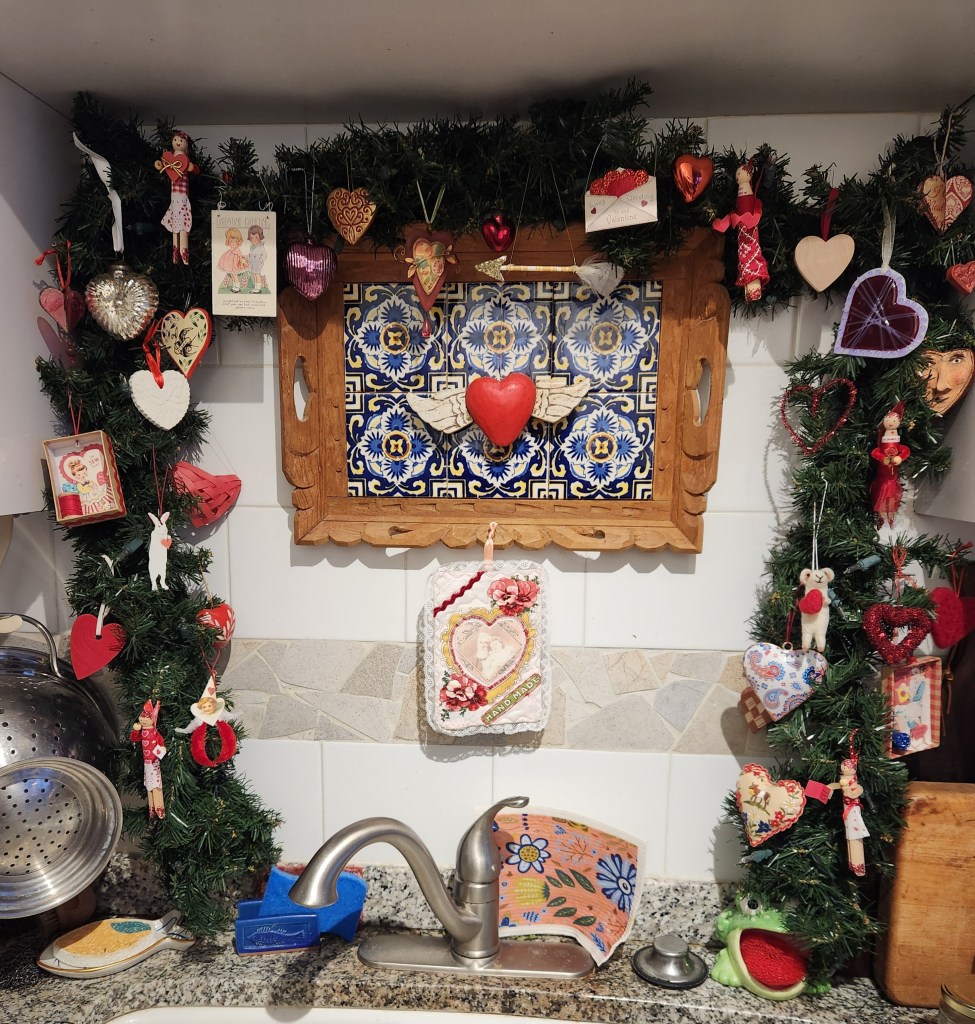
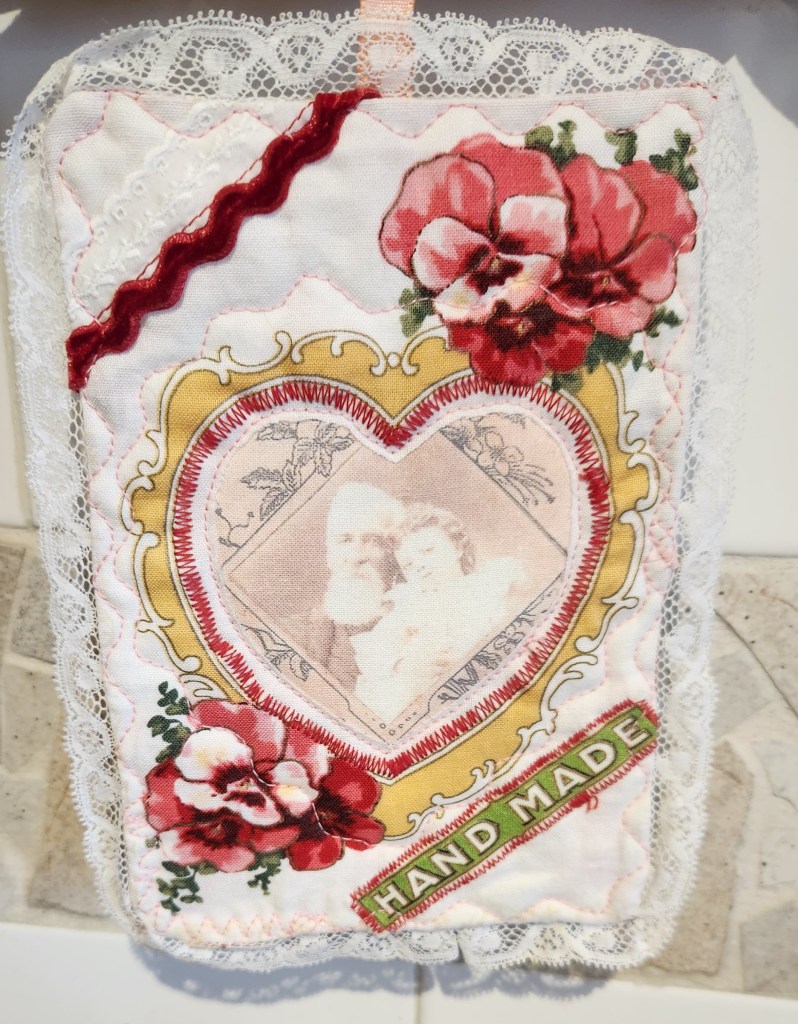
At Rushmer Christmas my Birmingham niece gave me a Valentine incorporating one of the family photographs I had printed on fabric when I was making last year’s ornaments. Since several of the photos wouldn’t work for making ornaments, I gave them to her. I knew she would have a good idea about how to use them. And she did immediately getting to work on this Valentine with the picture of her great great grandmother and her father.
When I got back from Rushmer Christmas there was a box waiting for me from some Northampton friends. In addition to the snowpeople I think I wrote about previously there was a cute little mouse holding a heart.
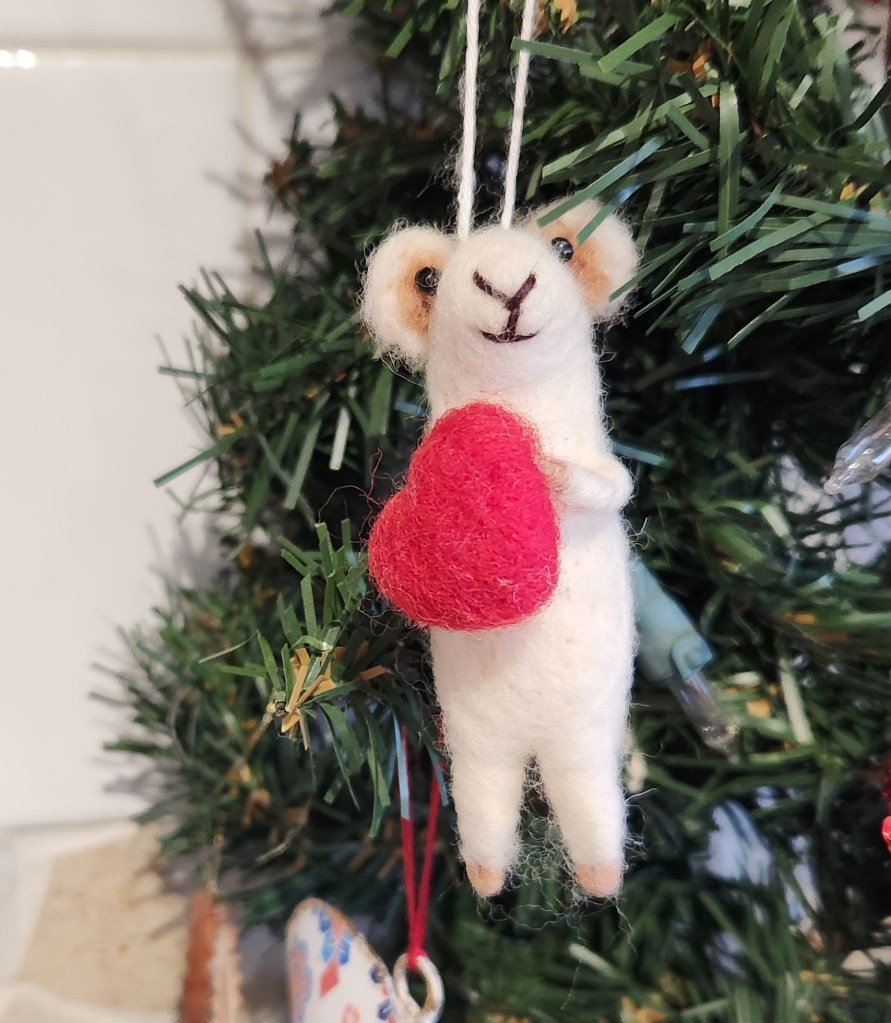
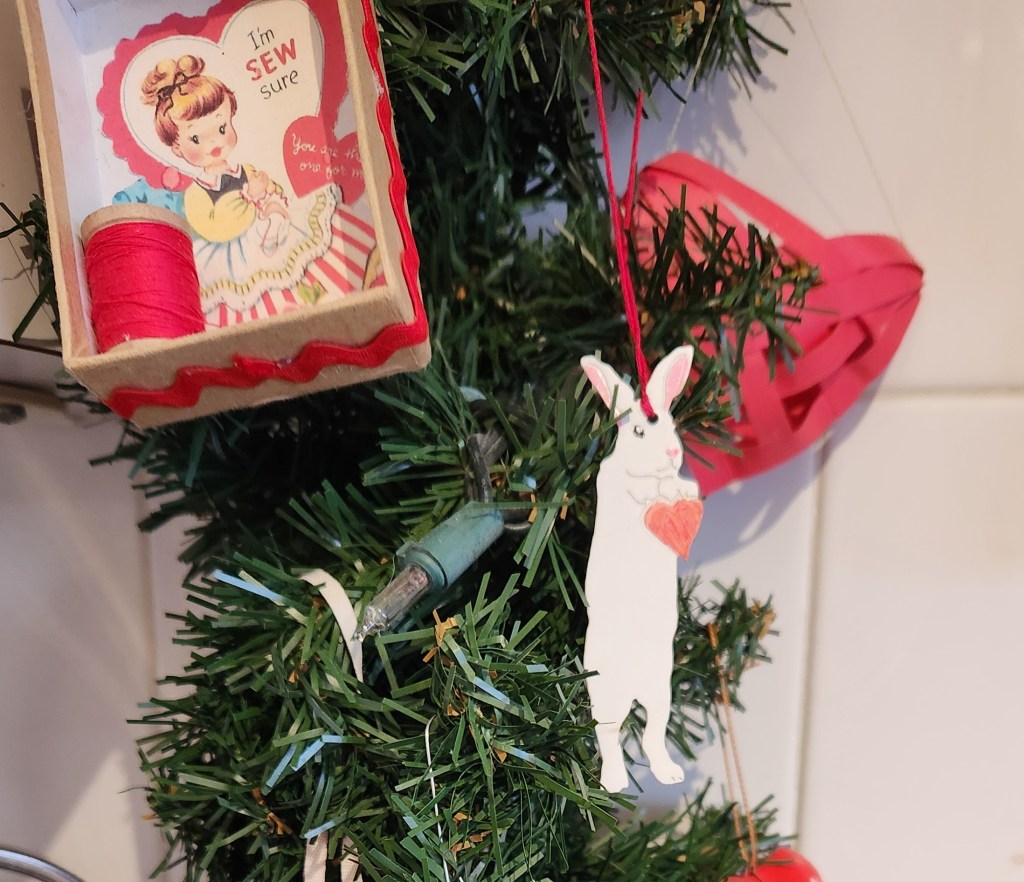
He seemed perfect for the Valentine garland and he reminded me of a bunny holding a heart that my Northampton nephew’s family had given me for Christmas years ago and that I had been using in my Spring decorating. I realized he was far better as a Valentine’s decoration.
Brittany of The House That Lars Built hosts a Valentine exchange each year and I thought it would be fun to participate and last June I realized what I could make.
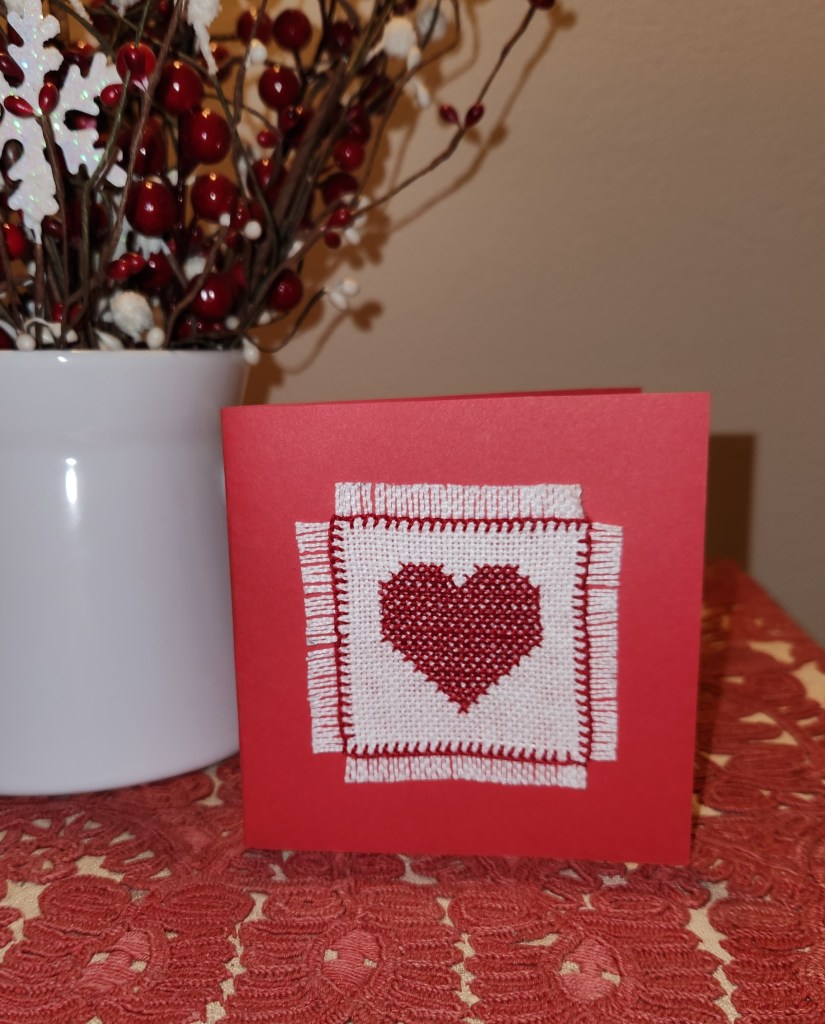
I made a larger card and several smaller cards that I thought I might put in a little art gallery. I had sent the exchange card off but hadn’t done anything with the little cards when I got a call from my sister asking me to come to Columbia because a recent doctor’s visit had determined she had tumors in her bladder and liver. So the little cards became my Valentine’s cards this year.
While I was in Columbia we went to Artlandish which had moved to a new location and increased their inventory. One of the things I bought there was this Peruvian heart.
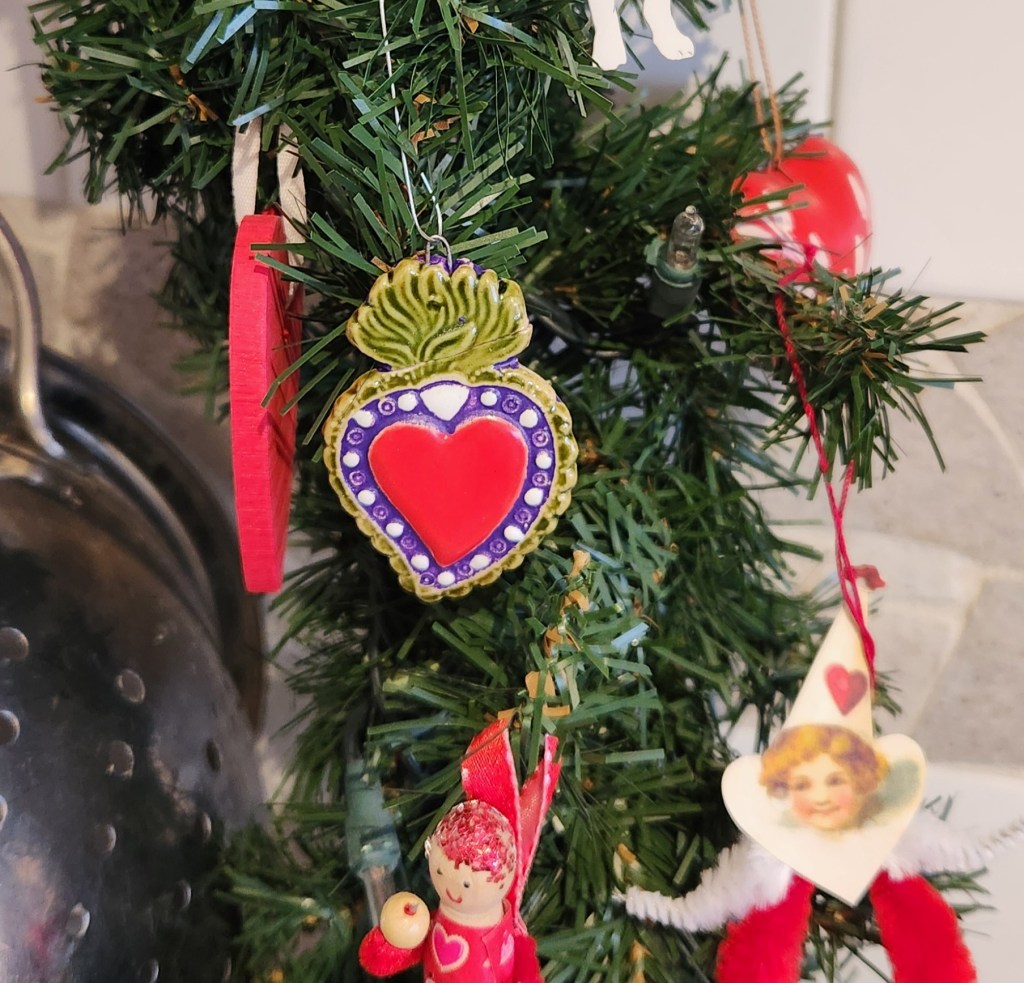
We also went to a Valentine’s party at my Columbia niece’s and were showered with Valentines made by her twins.
I had asked my husband to be on the look out for my valentine from the exchange but before it came I got a Valentine package from my Birmingham niece that included a Useful Pot To Put Things In.
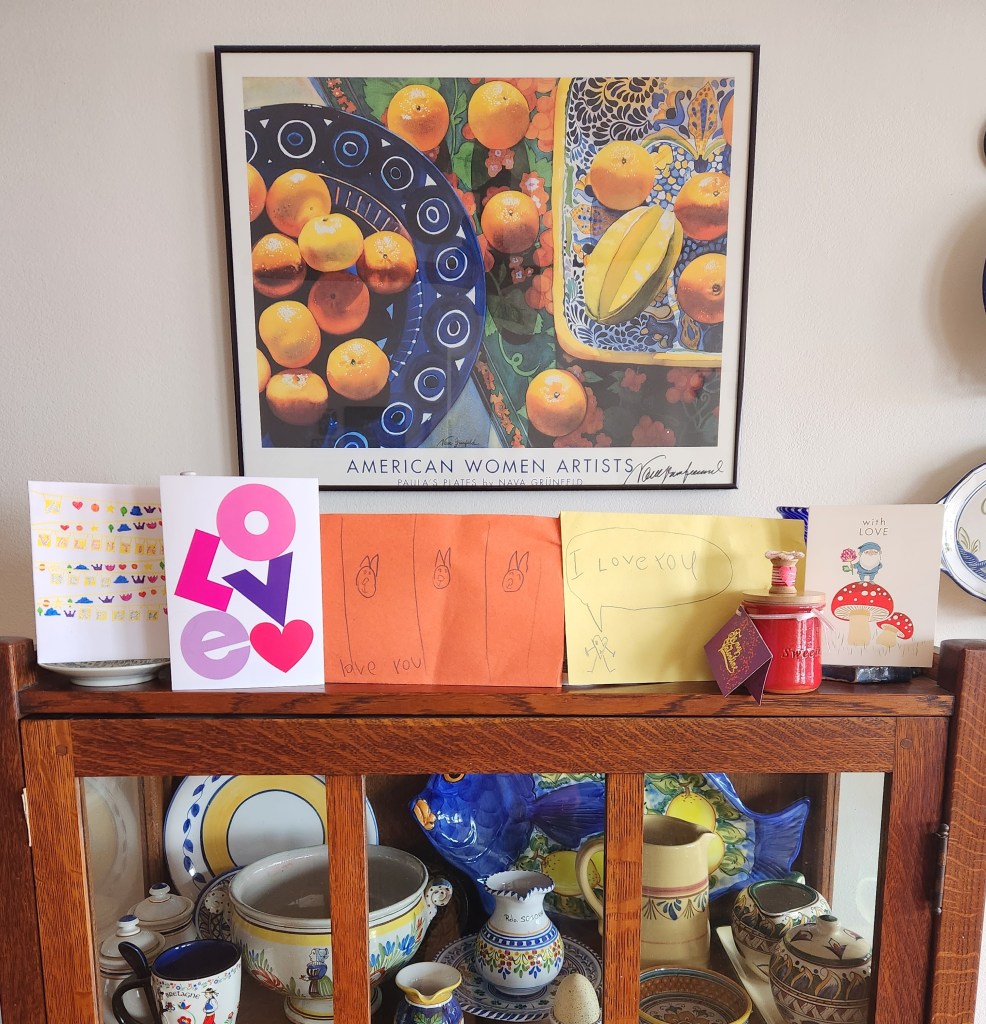
The Useful Pot is on the right in front of a card from a Northampton friend and one of the many cards from the Columbia twins. The card from the #larsvalentineexchange finally came and is on the left next to the card from my husband. I took some close ups to post on Instagram.
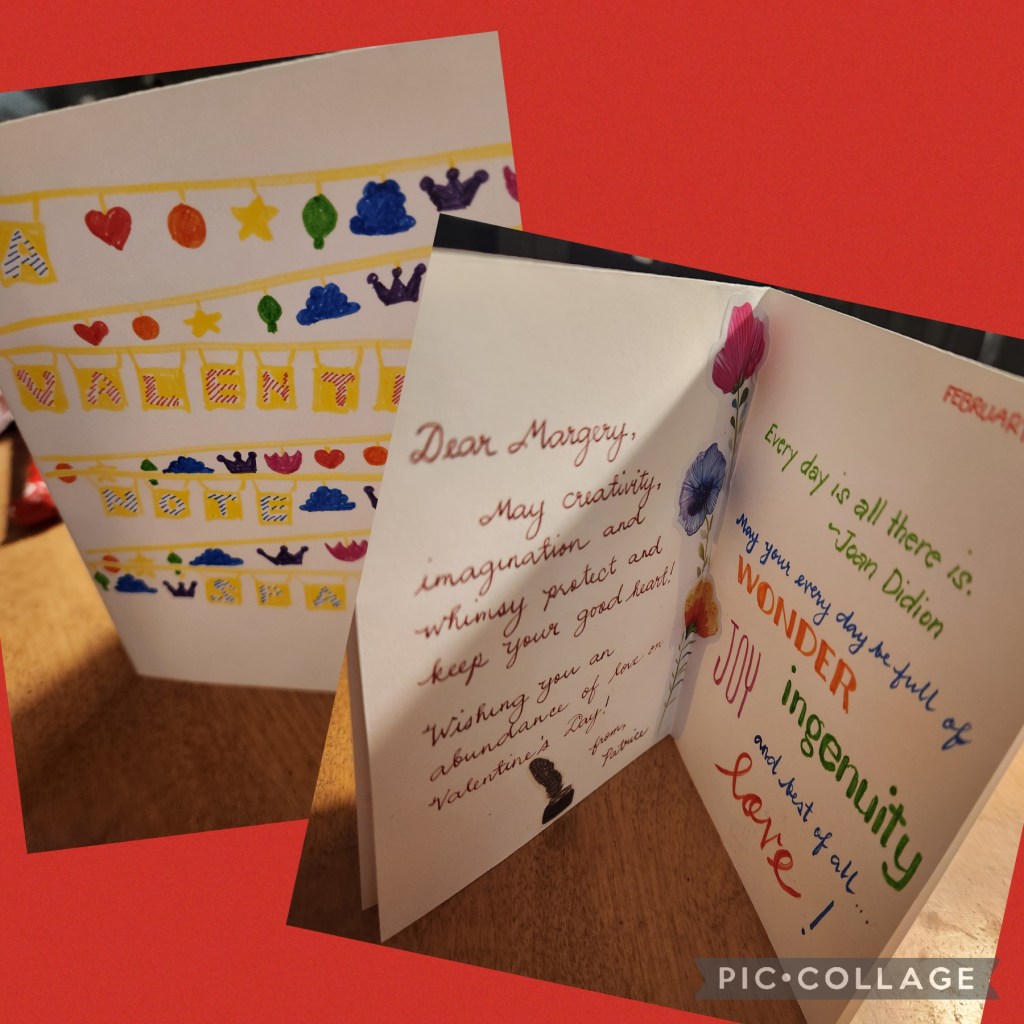
Participating in the exchange was fun but a bit stressful (Did the person I sent my card to get it? Will she like it? Am I going to get something? Will it be one of the extravagant ones some others posted which will make me feel like mine wasnt enough?) so I probably won’t participate again next year.

The first time we went to Columbia, Missouri for a music festival we stopped at a store called Artlandish and admired the paintings and prints by Lisa Bartlett. I realized that if either of us been there alone we’d probably have bought a piece for the other one. We went to Artlandish a few more times after our niece moved to Columbia but we were always together so we never left with a piece. But this year after my sister bought a house in Columbia, I went to visit her by myself and I was determined to buy a piece for my husband as a Christmas present. I bought a print of Little Walter and when it came time to hang it, it didn’t work in either of the places I had been thinking of. We ended up taking down the photographs of our daughters and the embroidered piece my mother had made and hanging it where those had been.
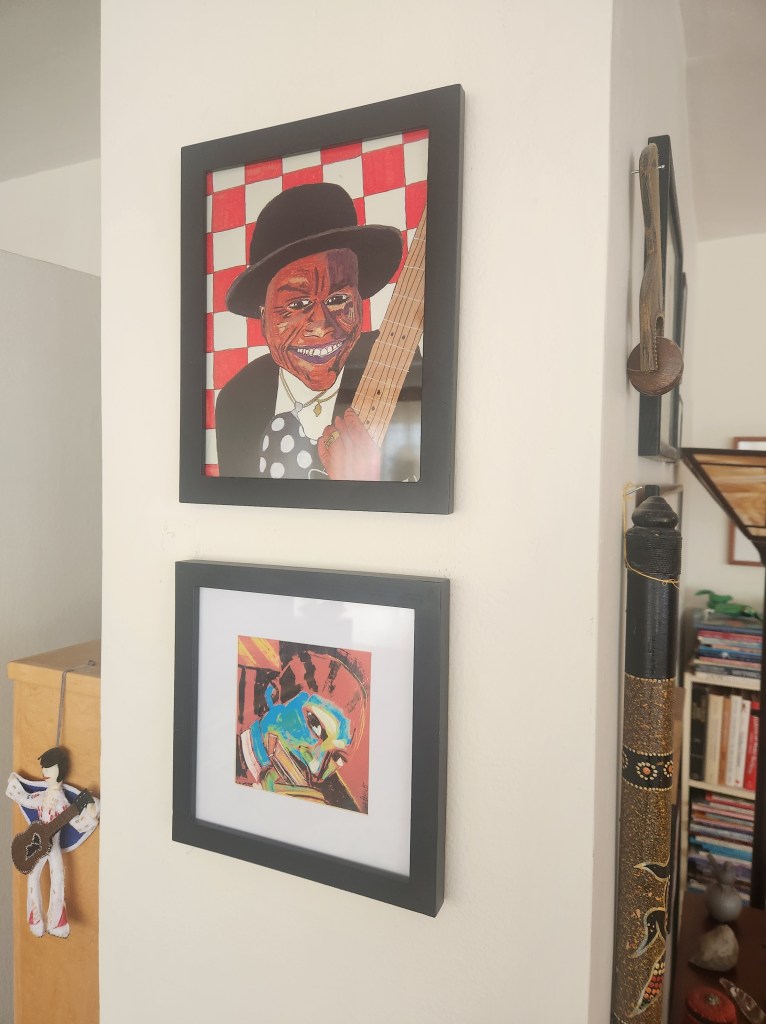
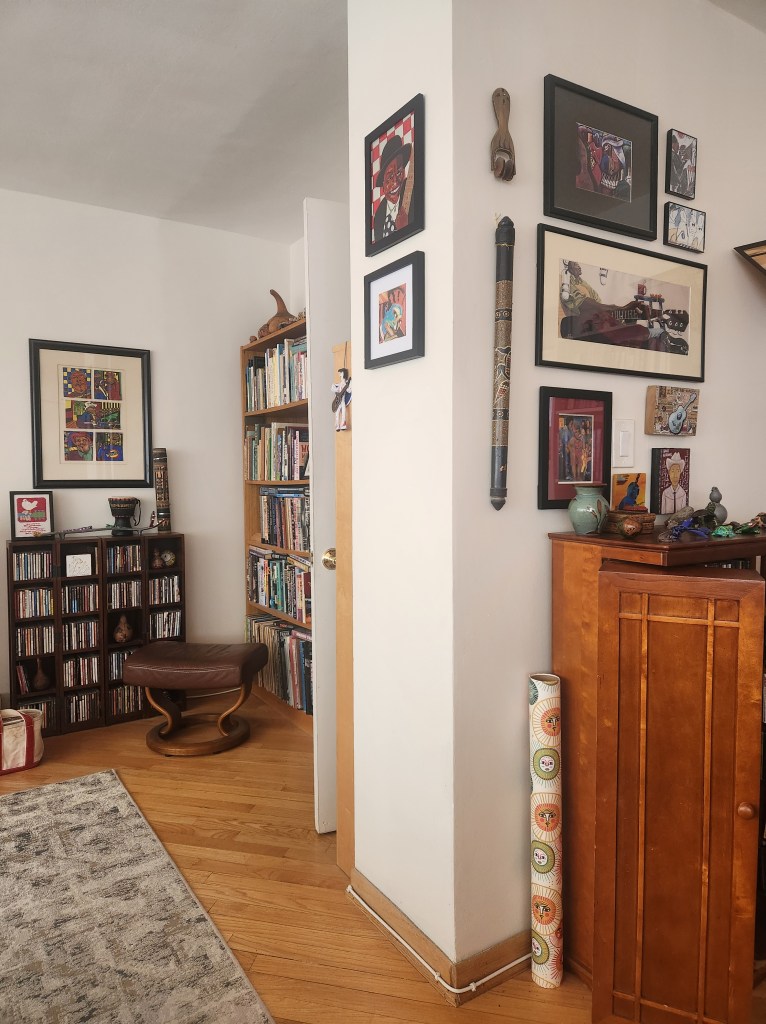
Since Little Walter couldn’t hang there all by himself, we pulled out another print I had gotten at a Poconos Blues Festival but never hung. The portrait of Buddy Guy is by Robert Jr Whitall a videographer, photographer, and publisher of Big City Rhythm and Blues magazine who became an artist during his extended hospital stays in the last decade of his life. I think hanging the pair here connects the prints above one CD case with the paintings by the Easthampton artist Denise Beaudet above the other.
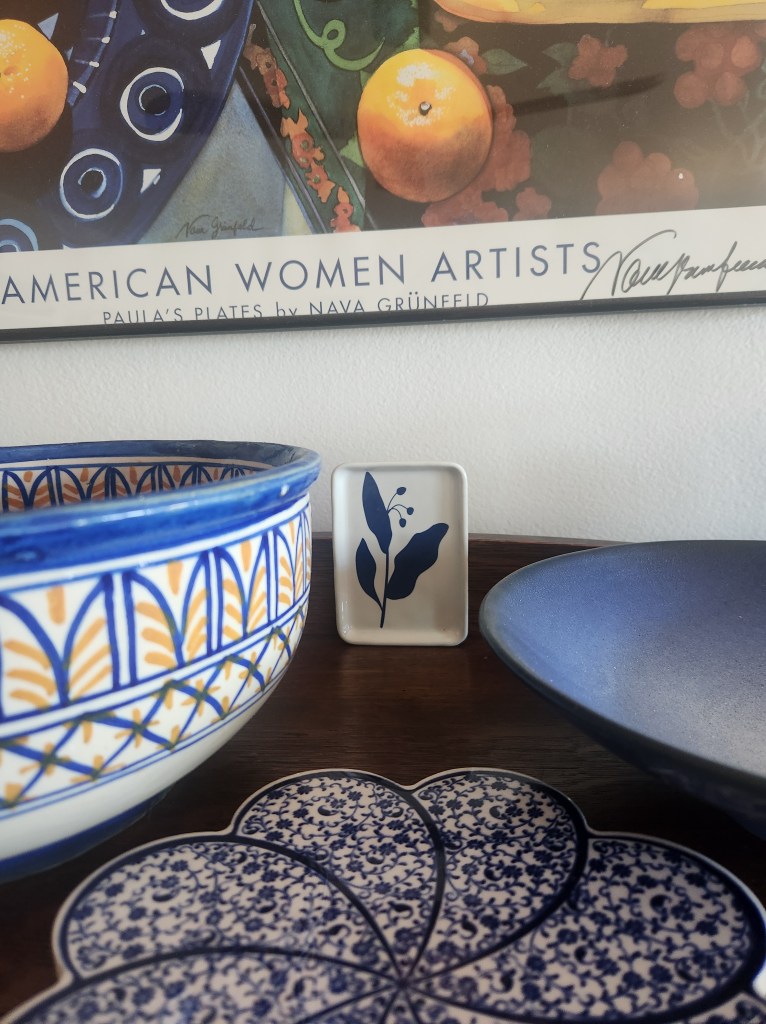
The china cabinet got an addition too – the small tray with the blue flower was in my stocking!
I had said I wasn’t going to overload the living room bathroom with birds but Rushmer Christmas resulted in some additions. When I saw an art vending machine at the Birmingham Art Museum gift shop I knew I had to get some tokens to see which print I would get.
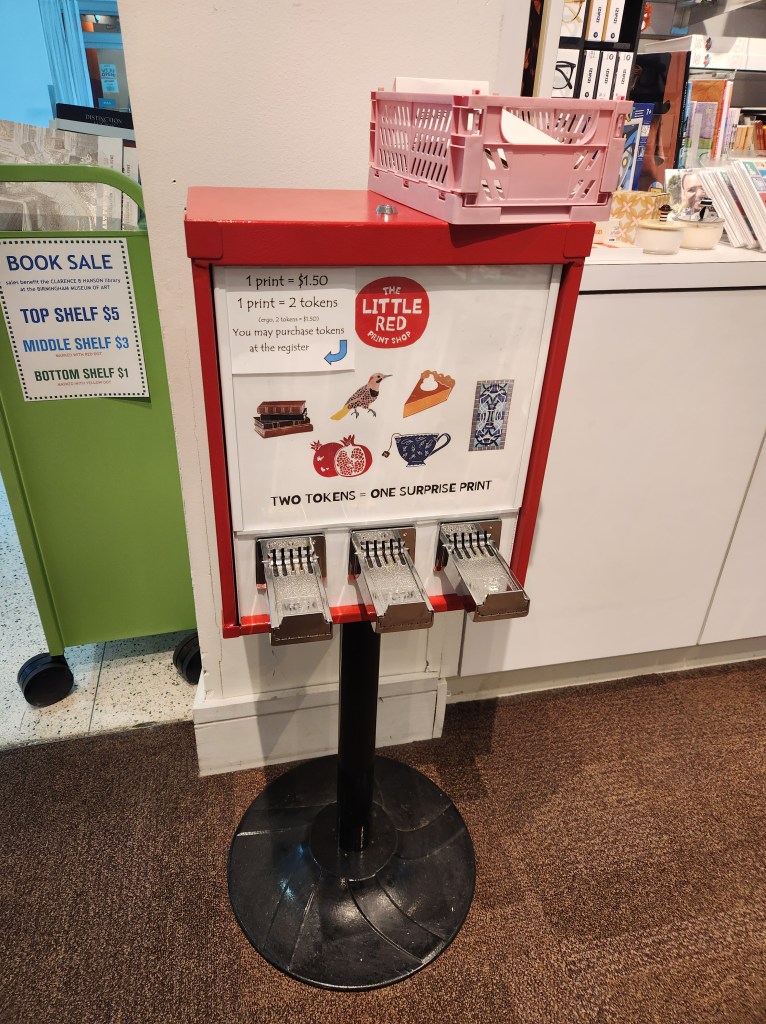
I got the Northern Flicker bird which turns out to be Alabama’s state bird. The next day at Rushmer Christmas we got these little place name holders crafted by my Birmingham niece with artwork by her daughter.
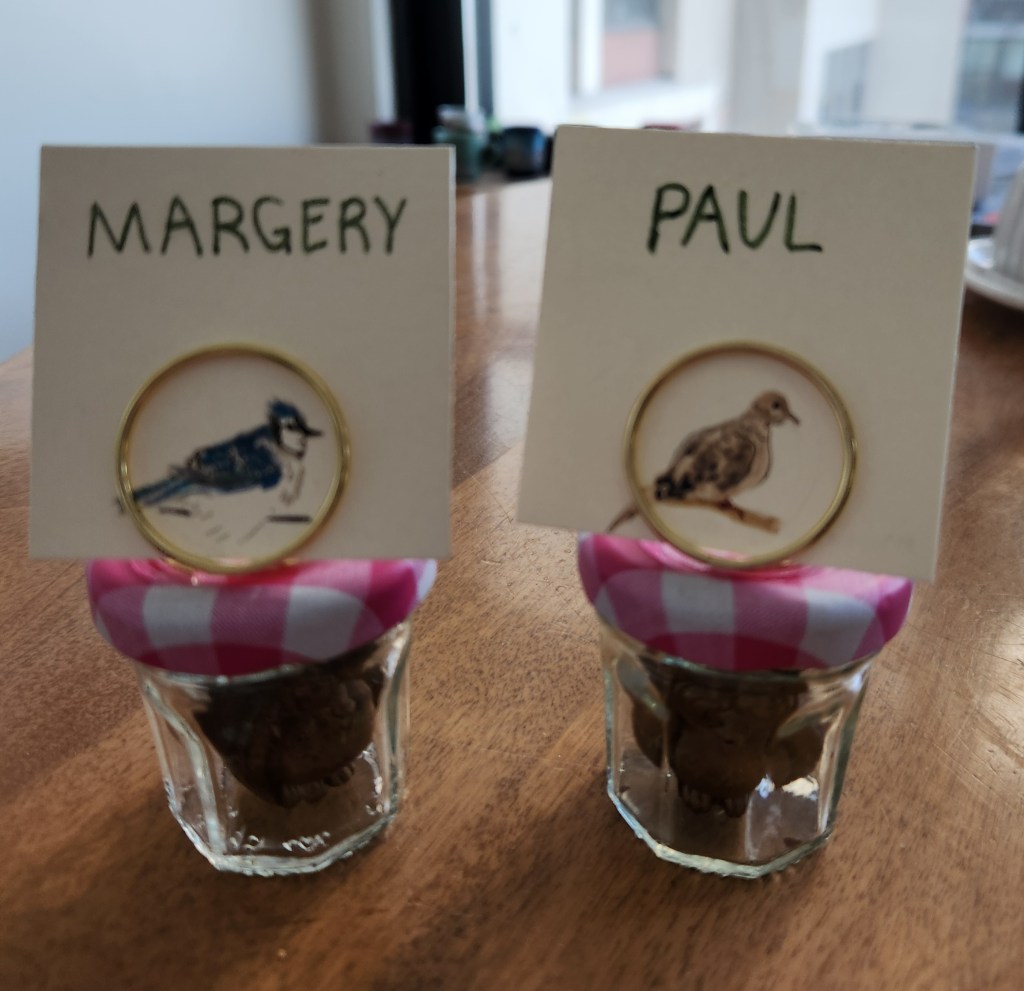
She informed us that all the birds were indigenous to Alabama and I knew I needed to create an Alabama souvenir with all our new birds.
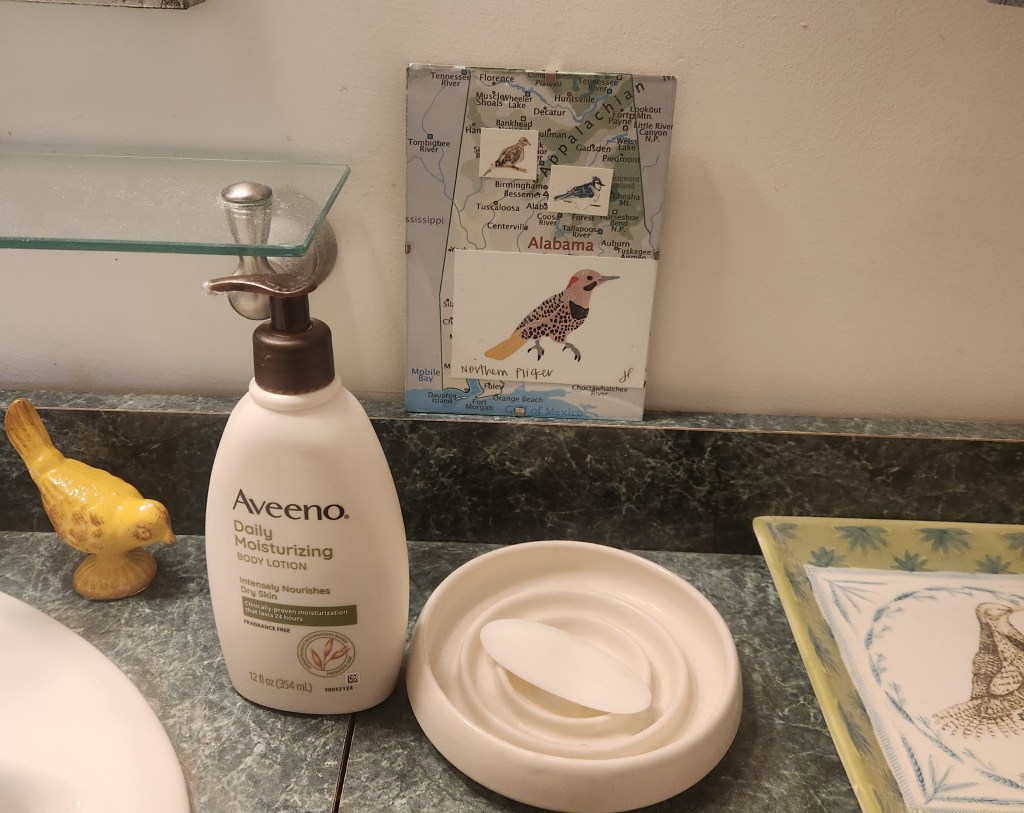
And that yellow bird didn’t really work where it was after we reaaranged some of the art above the cd case (incorporating can mean rearranging too) so he came to the bathroom as well.
My sister gave me a needle felted tapestry kit by Neysa Russo. The Scandinavian Deer reminded me of the deer on the sheets she had given me the year before so when I finished the piece, I turned it into a pillow that will go on our bed when we are using those sheets.
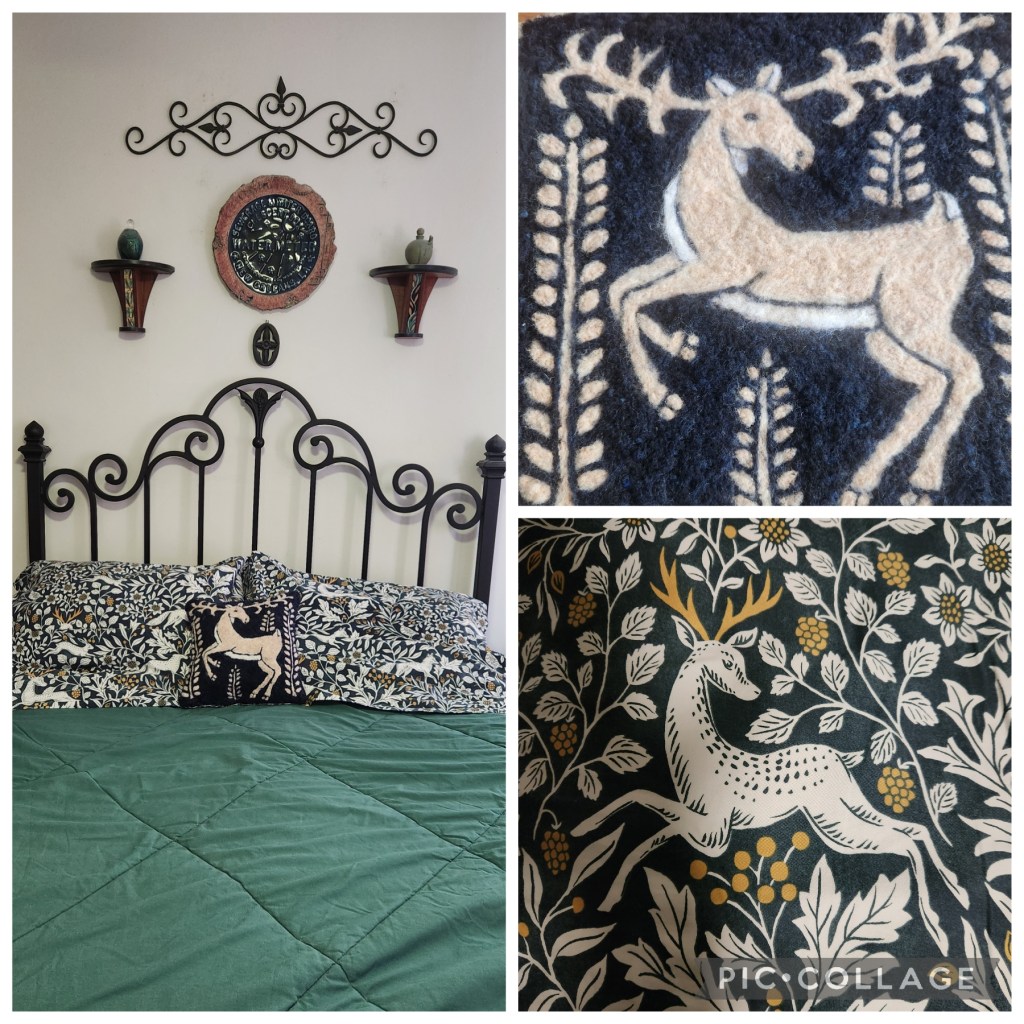
It’s so fun to incorporate new things!

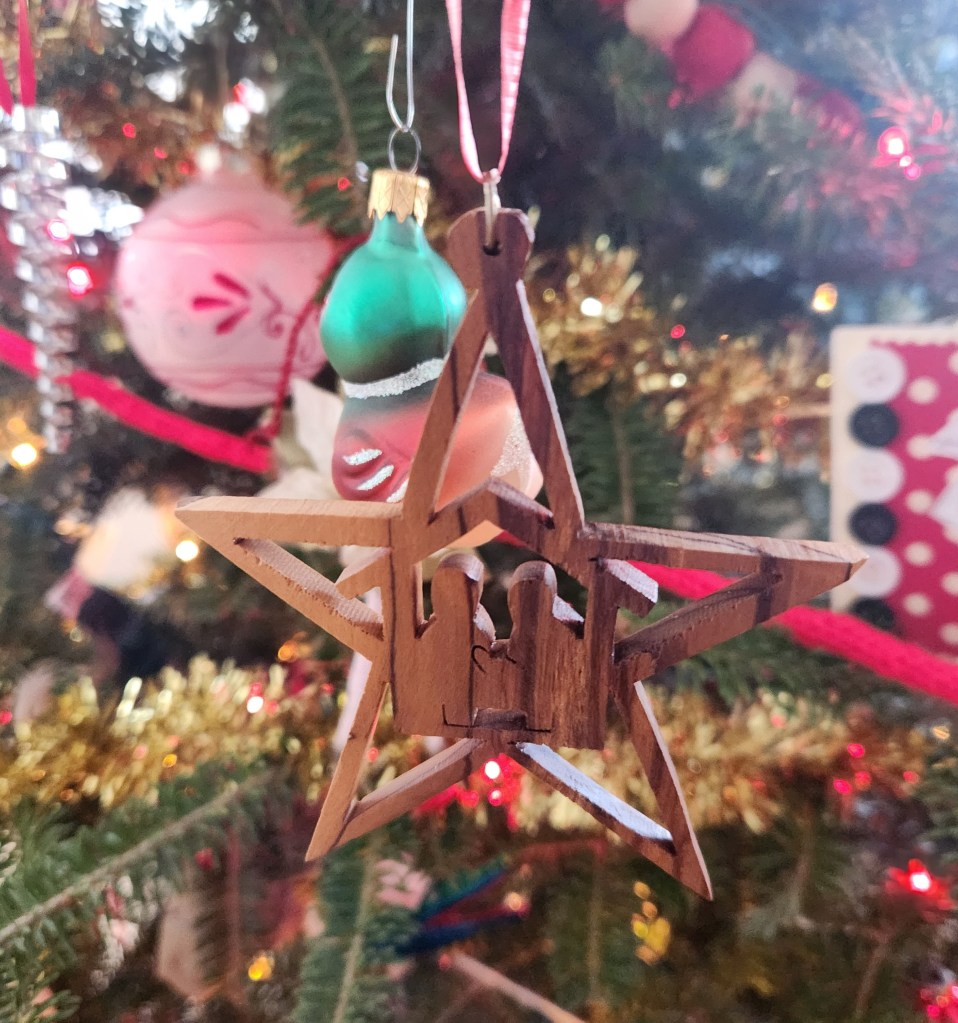
As we were putting all our Christmas decorations away today I remembered two things one was that I never posted the picture I took of the nativity that hung on this year’s advent calendar. So here it is. I bought it last year while Christmas shopping at the antique booth store in Andersonville.
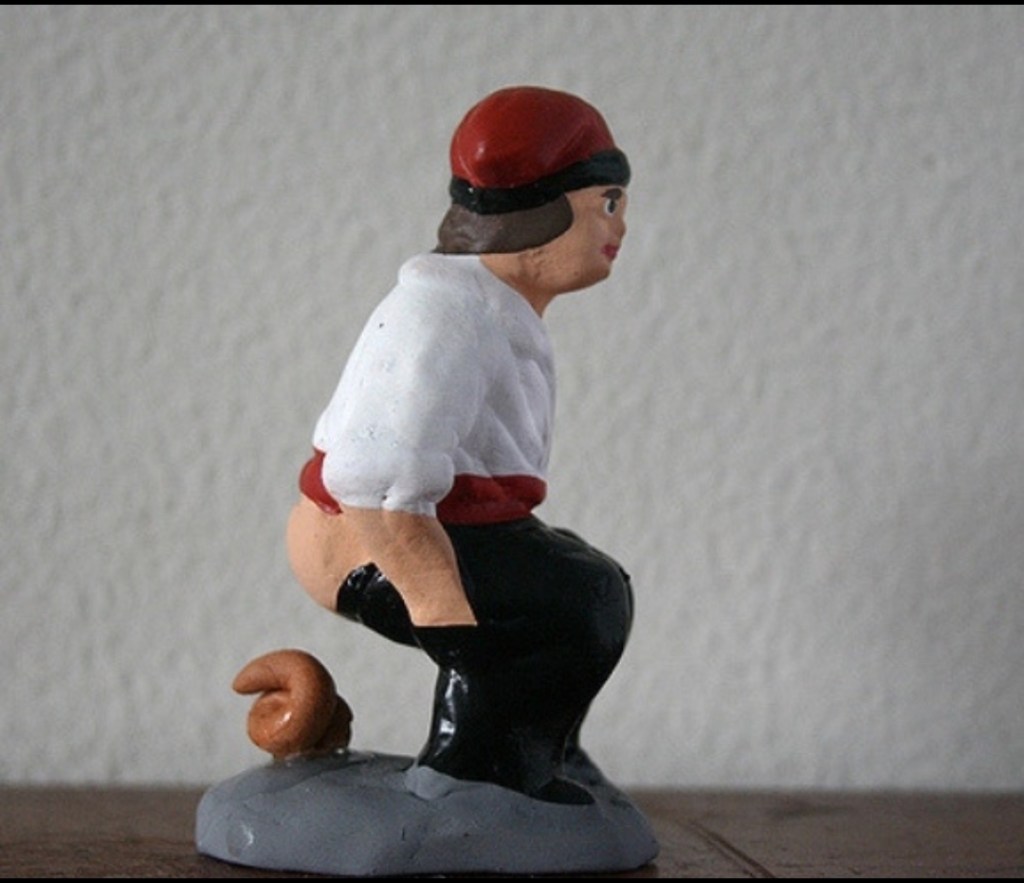
The other thing I remembered was that I wanted to write a post about two disturbing newspaper articles about crèche figurines I read this season. The first was a New York Times article titled “Lamine Lamal has a statuette of himself doing a poo: Its Christmastime in Catalonia”. The article explained that the soccer player was proud of his “caganer” because he understood the tradition unlike other soccer players who had been disturbed when their figurines were created. And what is a caganer? According to Wikipedia:
A Caganer (Catalan pronunciation: [kəɣəˈne]) is a figurine depicted in the act of defecation appearing in nativity scenes in Catalonia and neighbouring areas such as Andorra, Valencia, Balearic Islands, and Northern Catalonia (in southern France). It is most popular and widespread in these areas, but can also be found in other areas of Spain (Murcia) and Portugal.
The name “El Caganer” literally means “the pooper”. Traditionally, the figurine is depicted as a peasant, wearing the traditional Catalan red cap (the barretina) and with his trousers down, showing a bare backside, and defecating.
And if that wasn’t bad enough a few days later I read an article in the Tribune titled “Nativities casting Trump as wise man”. Apparently it is tradition in Naples, Italy to portray the wise men as contemporary celebrities. Soccer players have been popular in this role as well but this year Trump is the bestseller.
Words fail me!

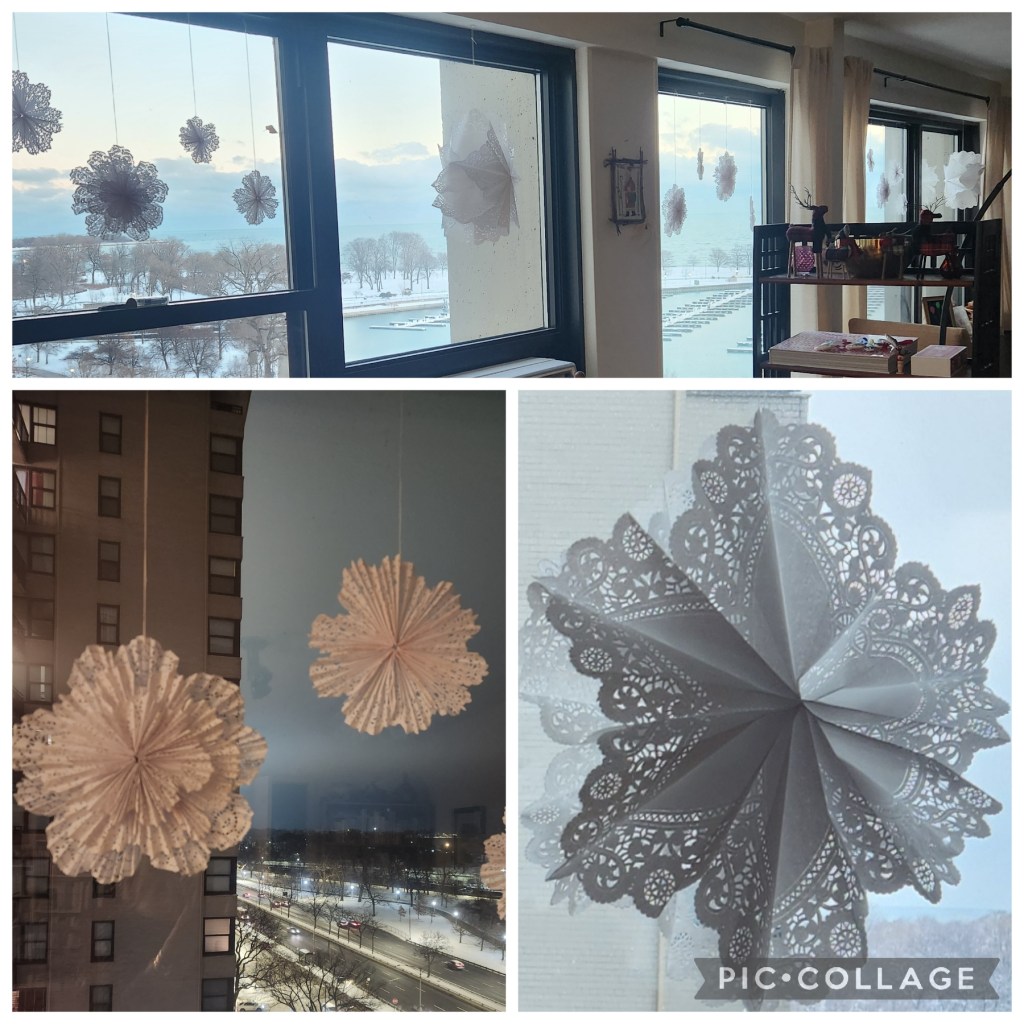
Many years ago I purchased a lot of doilies on sale, so when I saw snowflakes on Instagram made with folded and layered doilies, I thought I would make one large layered one for each of the dining room and living room windows. I reordered the large doilies I had used to make paper bag snowflakes a few years ago but it turned out that the folding method wouldn’t work with the large doilies so I ended up alternating windows with smaller layered and single accordian folded snowflakes and windows with large snowflakes made with the paper bag method.
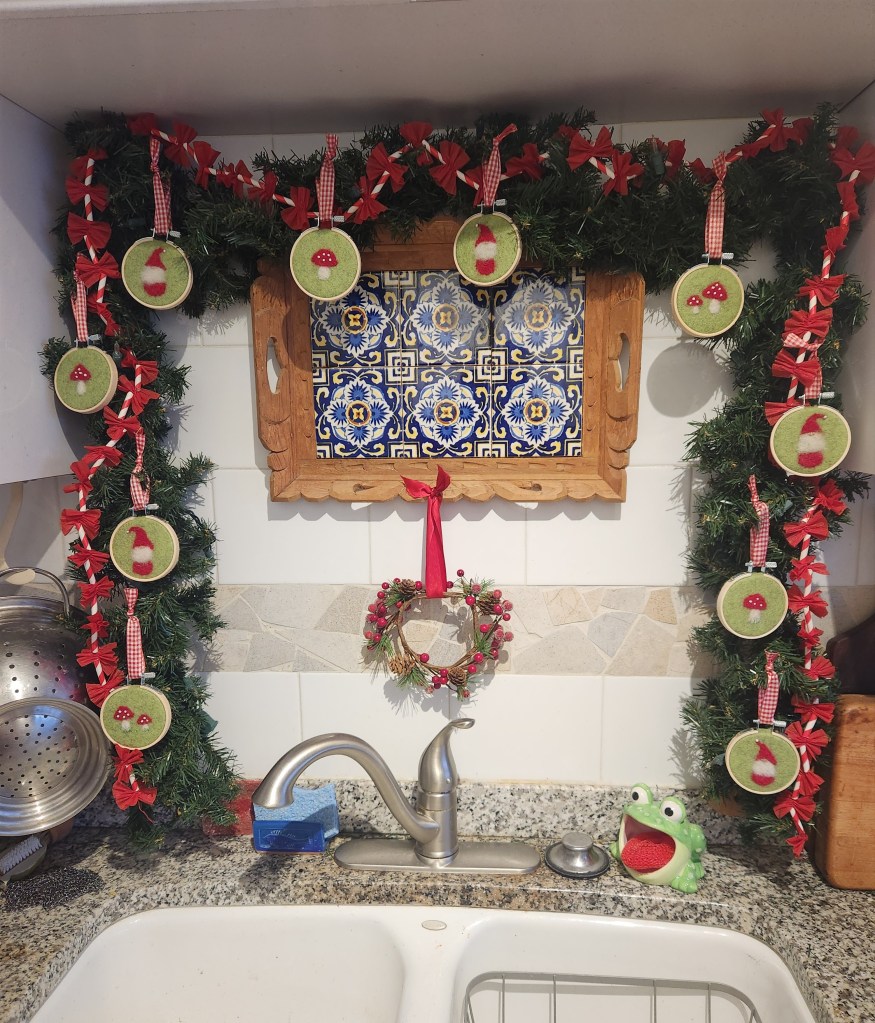
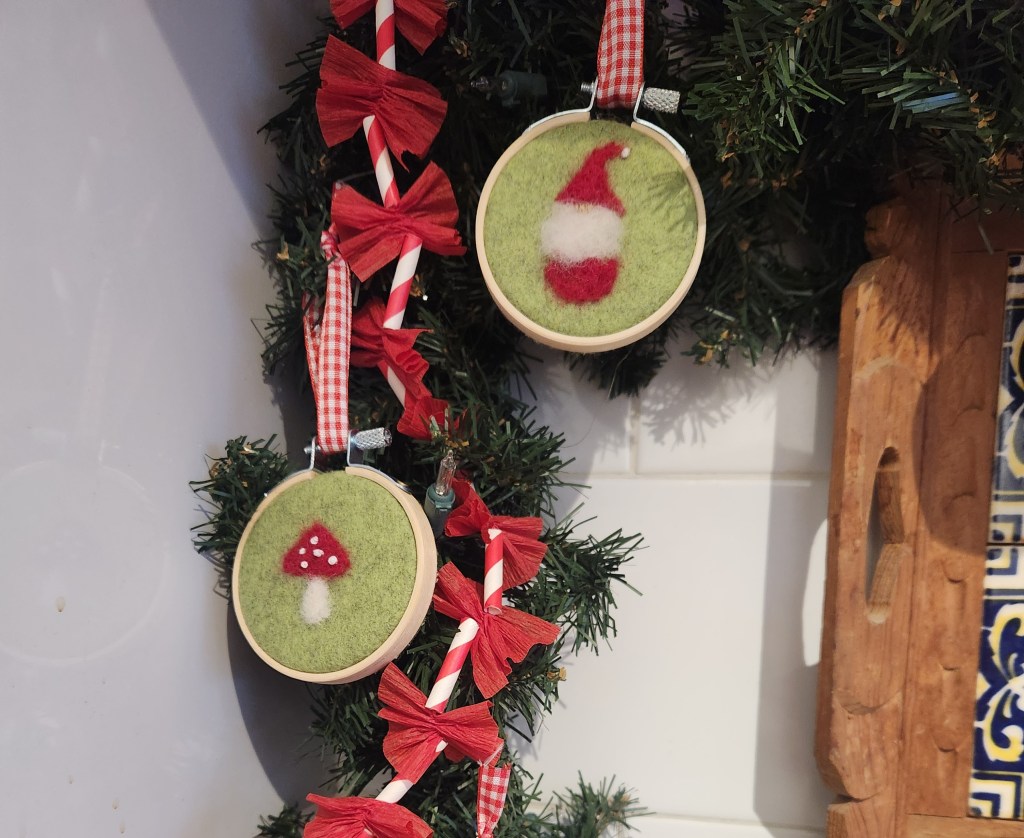
My idea for the kitchen garland ornaments this year came about as a result of a lot of different ideas coming together. When I was researching how to make felted pictures I saw some examples of small ornaments. An online workshop I had taken last year on darning with felting and embroidery had included a mushroom shape and when we visited Maydel, a new embroidery store I knew I wanted to make something with the mottled green natural felt they had. So I ordered small hoops, found Maydel in its new location, and designed a gnome to go along with the mushrooms. I knew the garland would need something else so I purchased some red crepe paper and got out the striped straws I had and finally made the new Polish choinka garland that I had been planning on making for years.
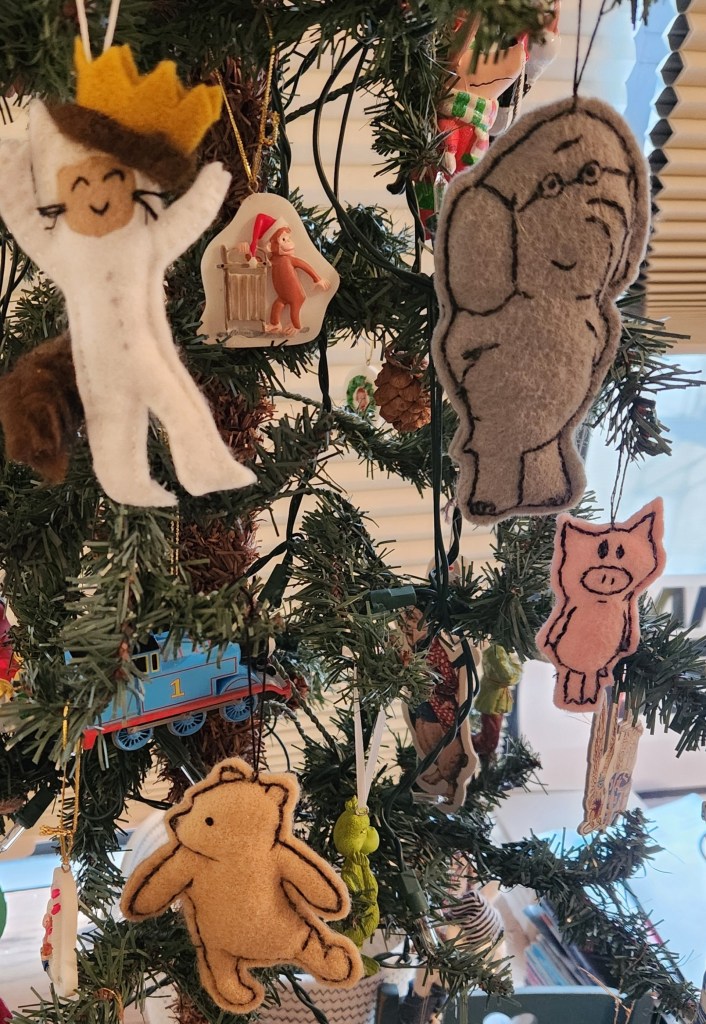
Only a few days after I realized my children’s book and movie character tree was missing Pooh someone I follow on Instagram posted a felt Pooh she had made. She made hers in white so mine is not an exact copy but I thought the shape she used was perfect.
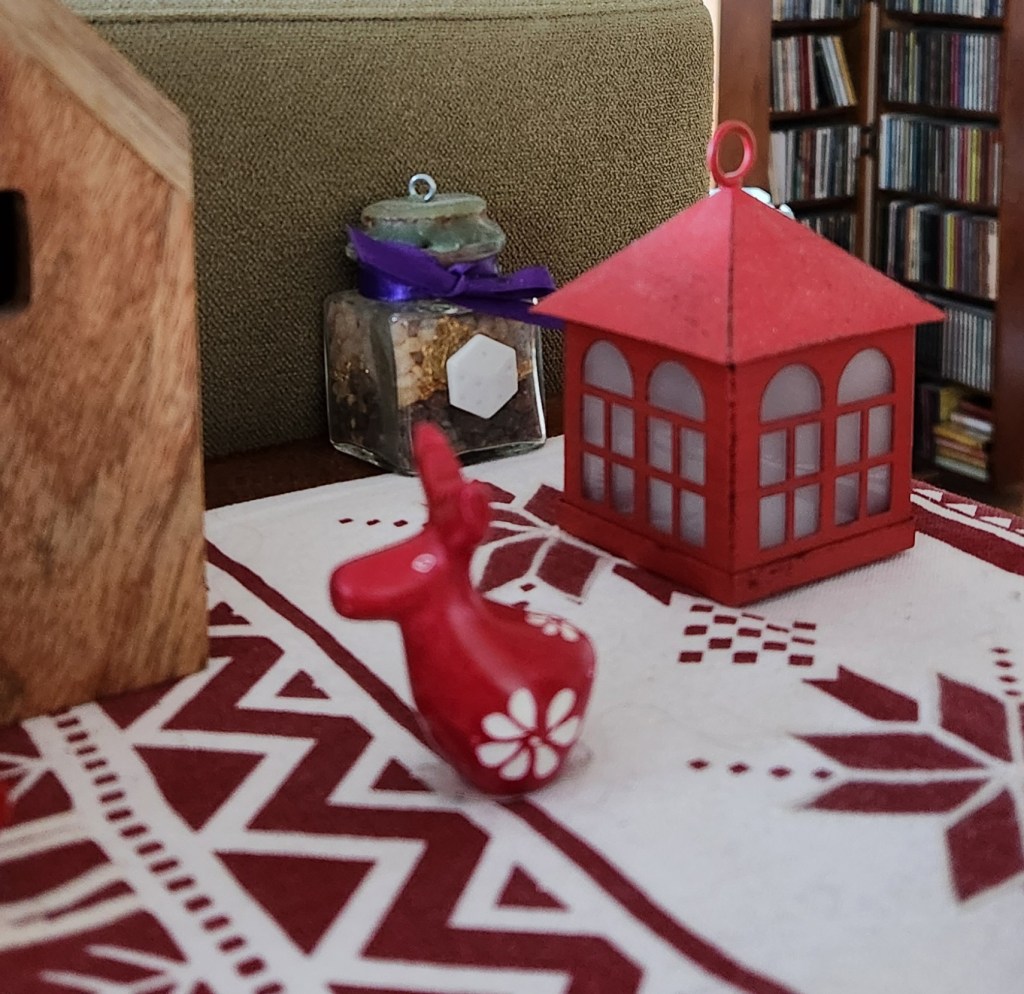
The only new purchase we made this year was this “reindeer bust of kisii” according to his label which needs to stay attached because his bottom is rounded and he falls over without it. He’s made of carved and dyed soapstone in Kenya and we bought him at Amazwi in Saugatuck.
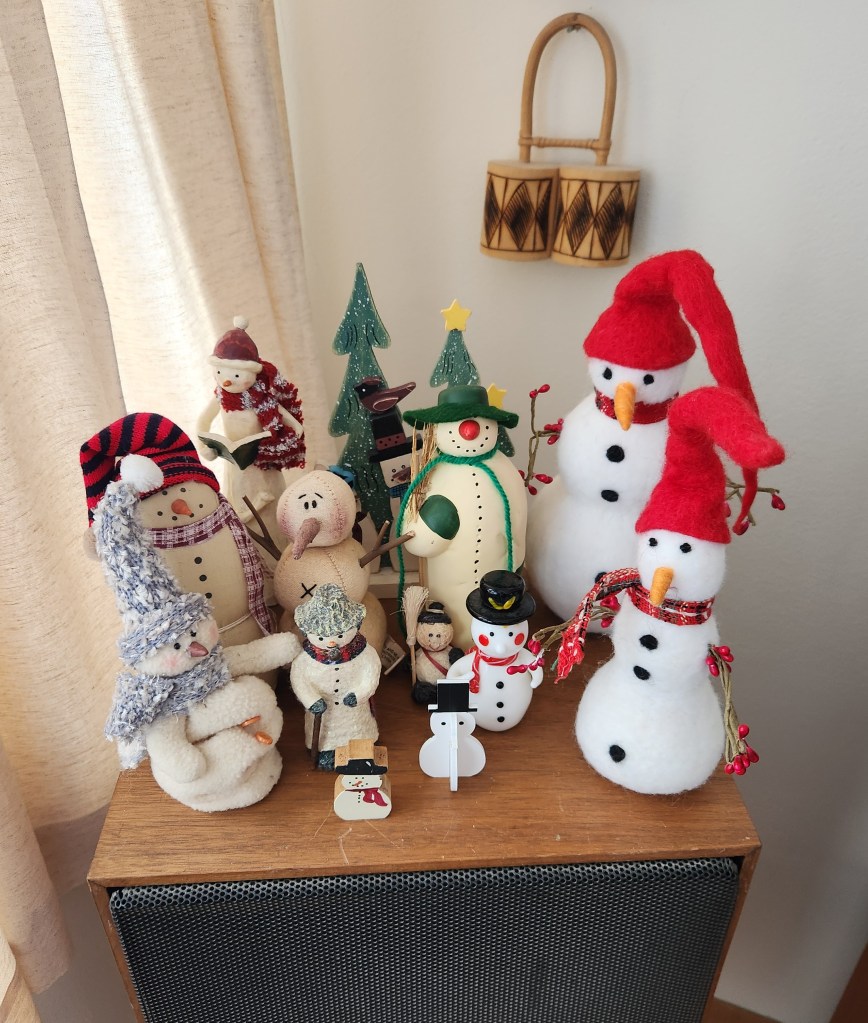
While we didn’t buy anything else we did get two new additions today. My Nonotuck friends Jen and Kimm sent the two snowpeople on the right. They made themselves right at home with the rest of the snowpeople in their traditional space on the lefthand speaker. Good thing we leave everything out through January!

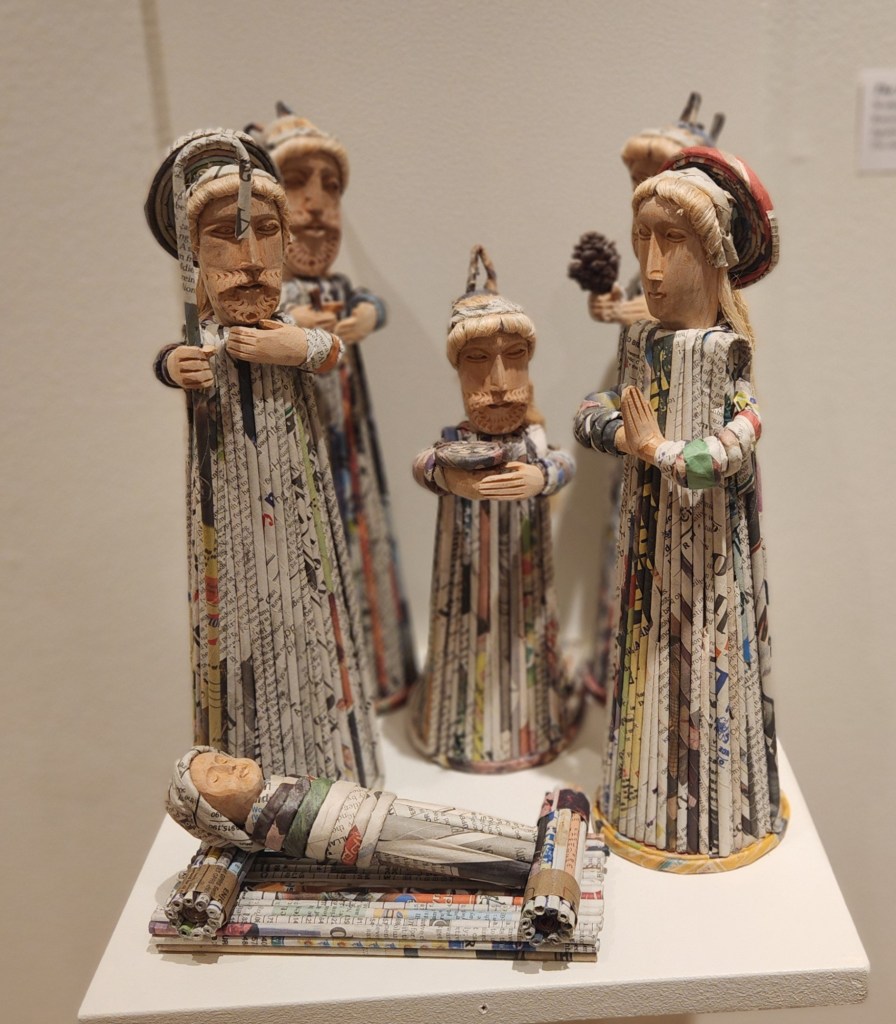
One of the things that is so fascinating about the Govan crèche collection is how many different materials artists have used to create the nativity story. I neglected to note anything about this rolled paper one but I think it is from somewhere in Africa.
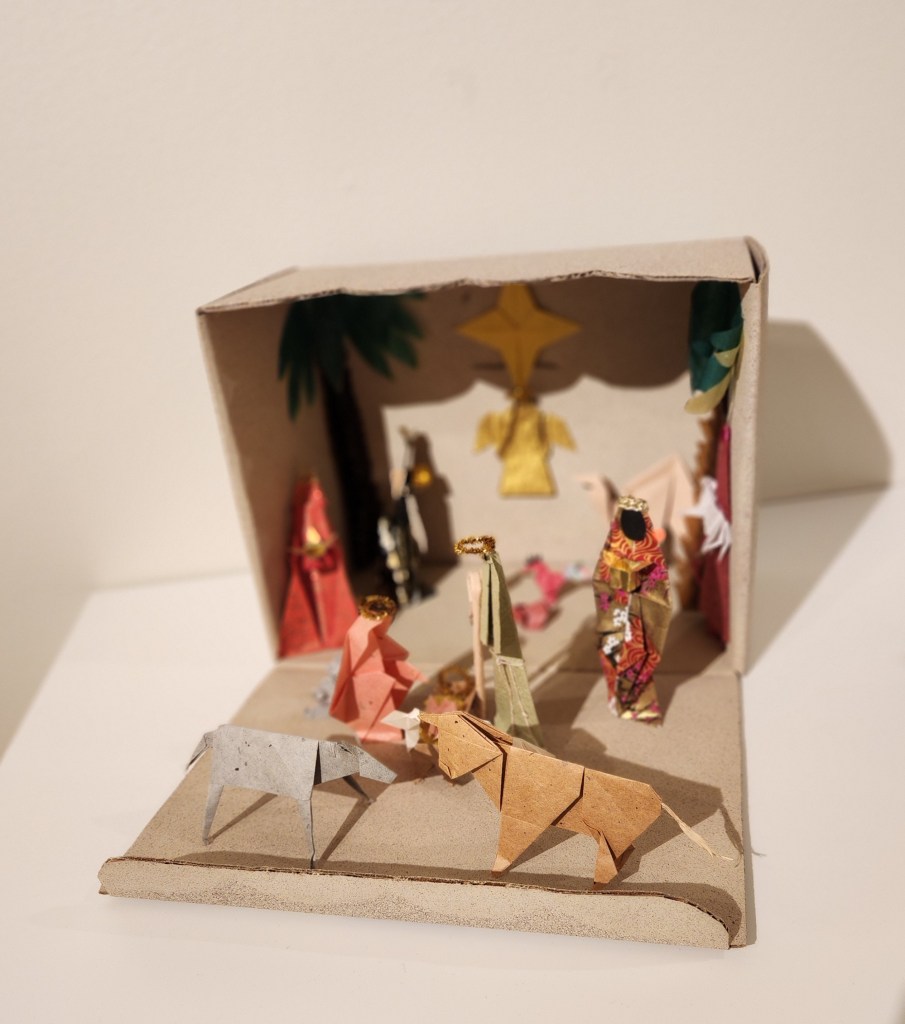
This completely different paper one is by Lila K. Ridley of South Carolina.

M. Eugenia Weinmann of Chile crafted this crèche from seashells.

This glass one is from India.
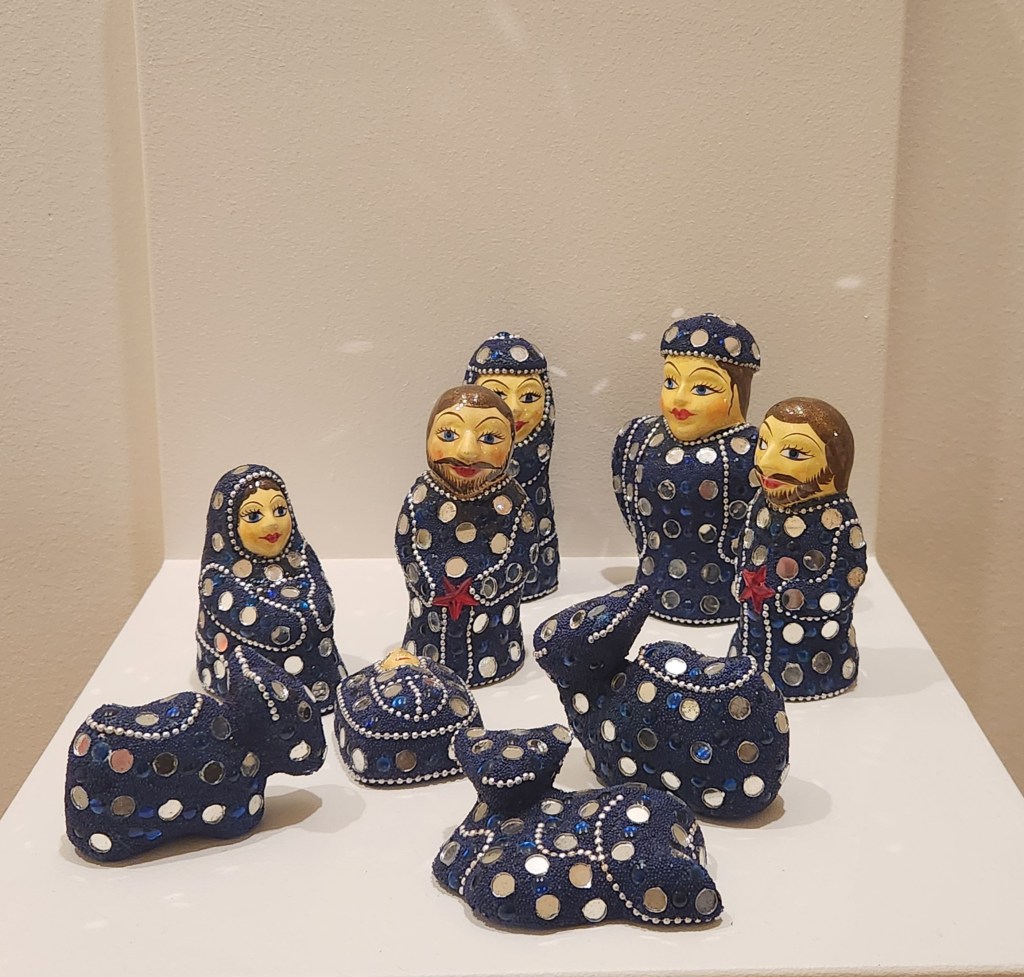
The sign on this ceramic one with mirrors and beads was a bit confusing as it says it’s from India but then lists the artist as Barbara Ryan, USA.

Another one from India, this metal one was made by an unknown artist.

This painted clay one from Portugal was one of my favorites and is interesting as two artists are listed one, Quinara, made the figures and another, Robert Davis, the altar. This crèche is one of the ones featured in the book I have about the collection. Presenting the figures on an altar like base like this originated in the late 1920’s in Estremoz a small town east of Lisbon. The inspiration came from the presentation of popular saints at festivals on large staircase thrones. The “altar nativity” became a miniature version of the festival shrines.

This wood, fabric, paper, and metal one from Thailand is by Khunjing Tongkorn Chandavime.

I love the three kings in this painted clay one from an unknown artist in Egypt.
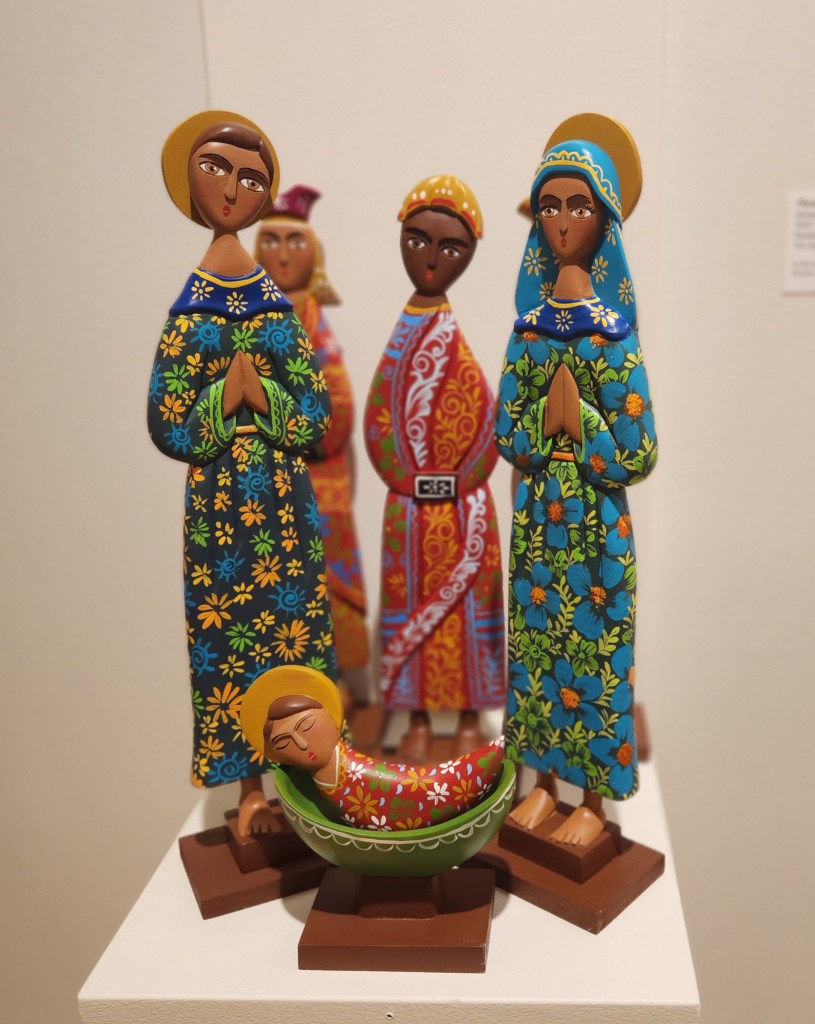
I think this one is painted wood and is from Nicaragua.
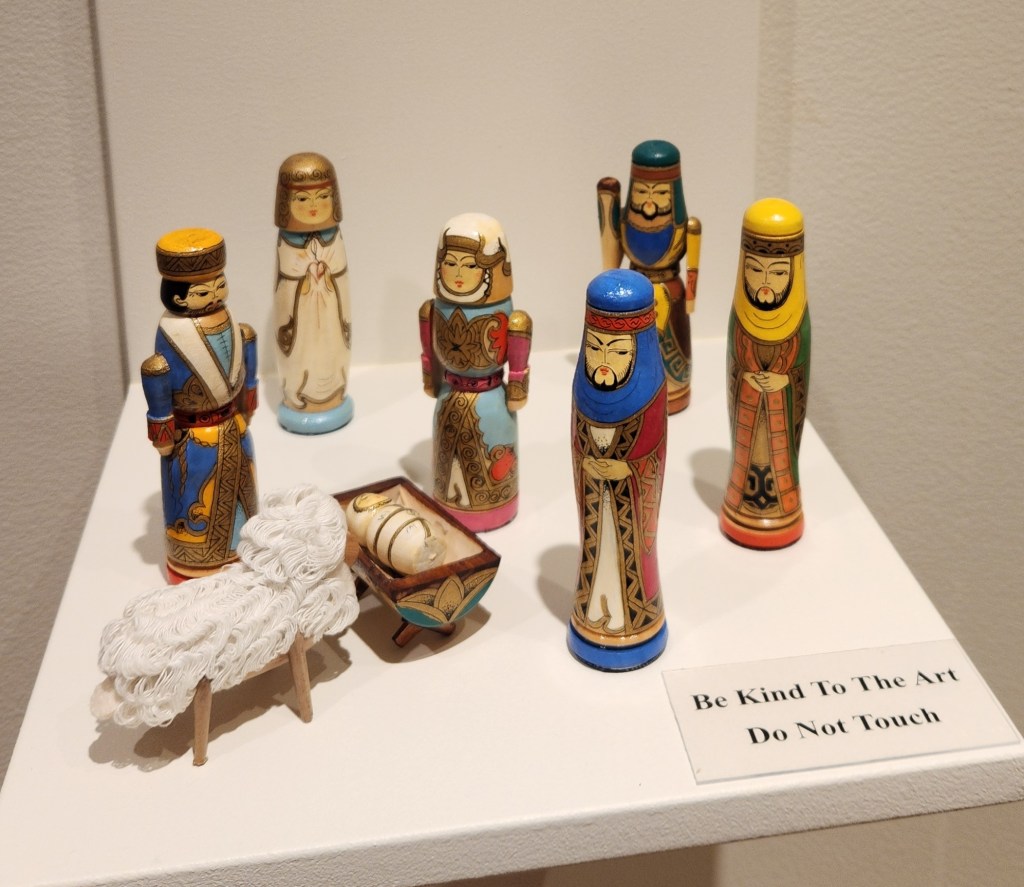
I guess the curator or installer thought this painted wood one from Kgrgysten looked particularly inviting as it was one of the few with a Do Not Touch sign.
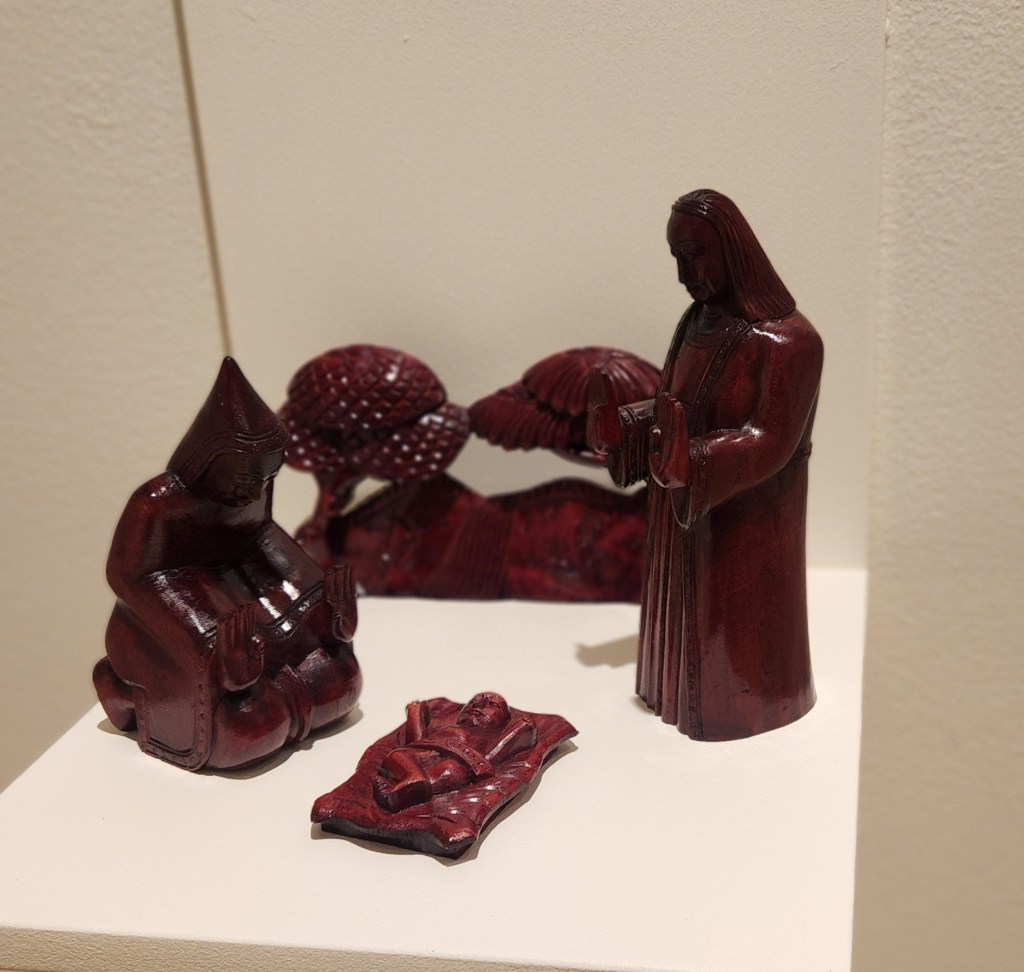
This one from Nepal was crafted with Karma wood by Narayan Shilpakor.

I’ll end with this one I neglected to get any information about. I particularly like the angel on the top!


Some of the creches in the exhibit at LUMA were commissioned by James Govan and the artists often execute the nativity in a way that reflects their culture as in this Alaska Crèche by Linda and Bruce Berget. As Govan points out in a video showing as part of the exhibit, the celebration of birth is a universal experience.

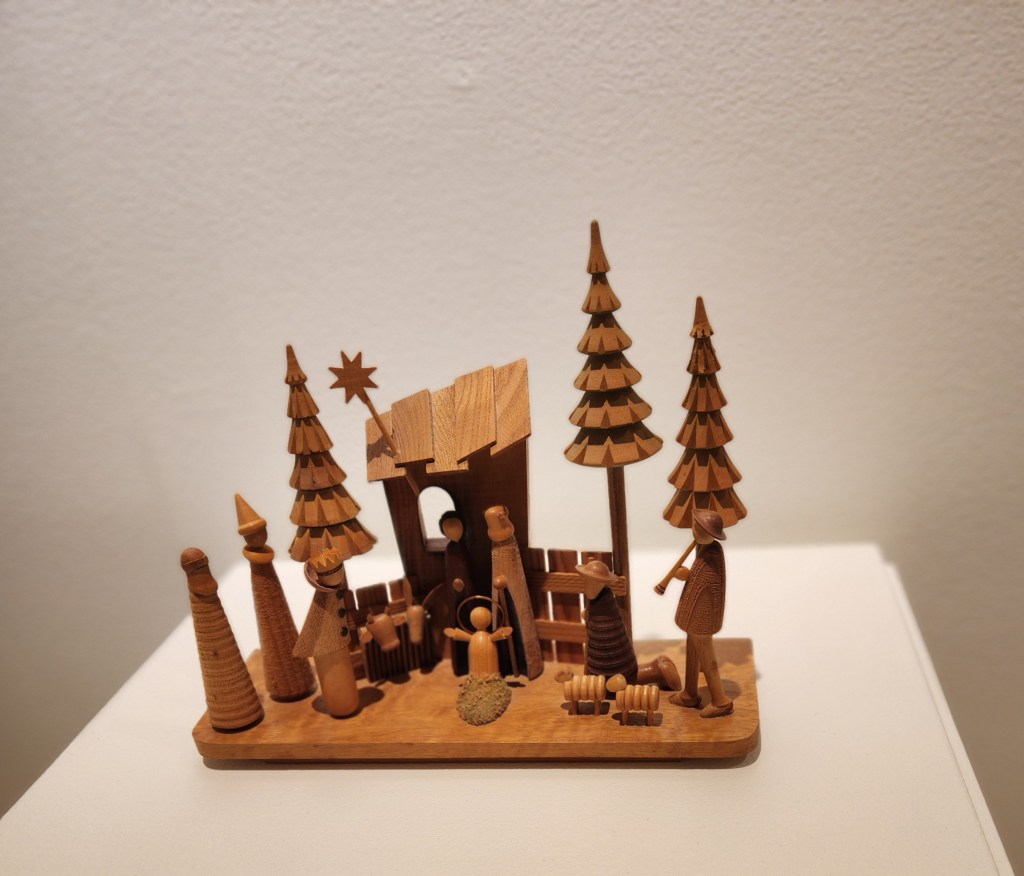


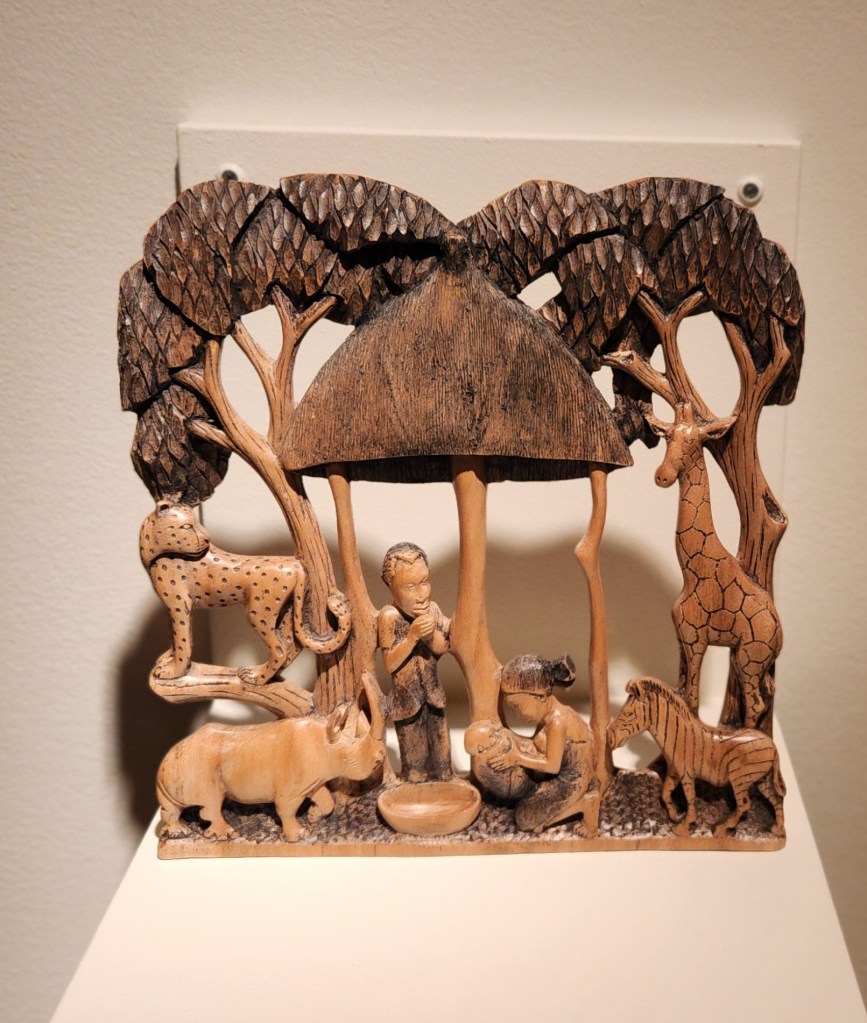
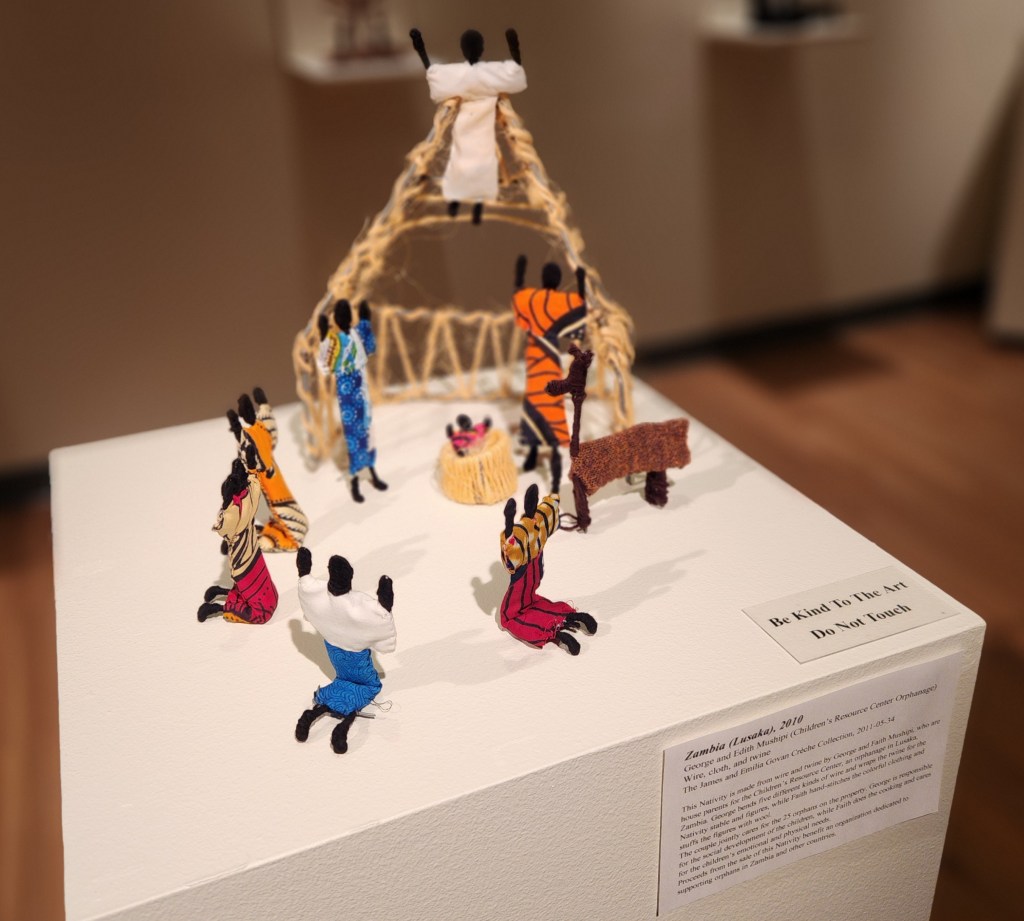

The above nativity scene includes animal skins and feathers. It’s fascinating to see all the different media that have been used by artists throughout the world. More on that and more favorites in the next post!

The annual Art of the Crèche exhibit of nativities from the Govan collection at the Loyola Museum of Art was back in full force this year. There were so many wonderful ones that I hadn’t seen before that I couldn’t stop taking pictures of them. So I’m going to write more than one post about them.

This one from Mexico was the first one to catch my eye. Check out that skull at the bottom. There were two more folk art ones from Mexico I loved as well.


I was especially excited to see the Santos or little saints from the French region of Provence because I recently read a book called “The Art of Living in Season: A Year of Reflections for Everyday Saints” by Sylvie Vanhoozer who grew up in Provence. Each of the chapters of the book focuses on one of the santons from a typical Provence crèche.
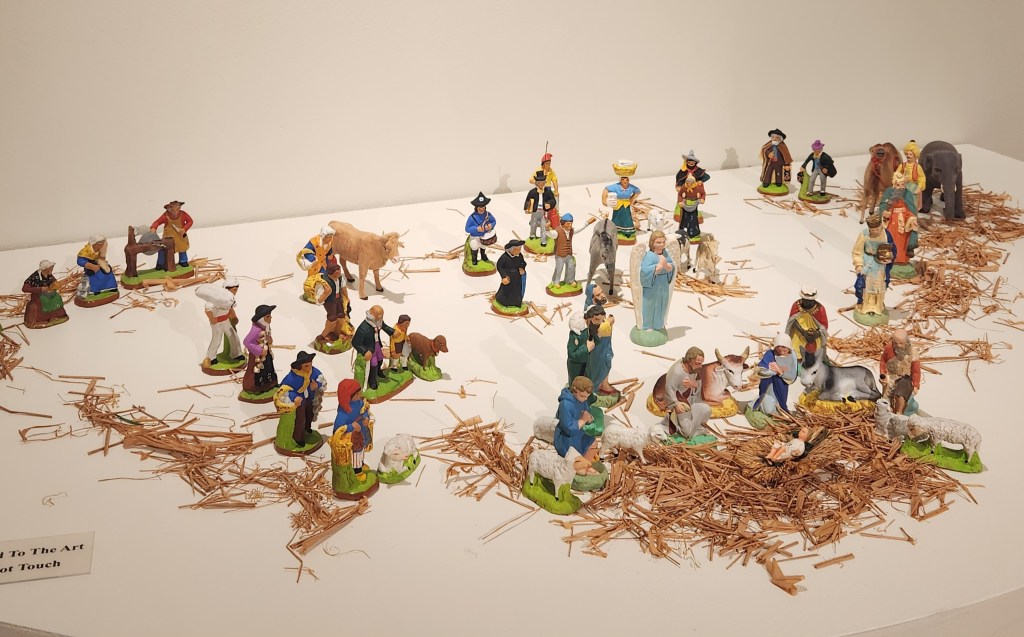
The book includes illustrations of each of the little saints by the author and it was wonderful to get to see them in person. The santons in the exhibit were created by the Workshop “Santons Marcel Carbonel”. The late artist Marcel Carbonel was the first “santonnier” to fire the clay figures that artists had been making since the late 1700’s. The figures include typical rural people from Provence each carrying a gift for the baby Jesus including L’agriculture (the farmer), La femme au fagot (the woman with kindling), and La poissonniere (the fishmonger).
I am mostly drawn to the folk art nativities by an “unknown artist” as the exhibit labels say or by artists working in traditional styles but I also appreciate some of the more modern interpretations. I don’t think I’ve posted a picture of this one constructed of found wood by Jean Morman Unsworth in 2011.

Stay tuned for more crèche posts!

Ella Jenkins “the first lady of children’s music” collected spinning tops during her travels around the world and she willed them to the Chicago Children’s Museum. They are currently being displayed along with information about Ella and other artifacts in the Eleanor C. Beidler Changing Exhibit Display on the second floor of the museum.
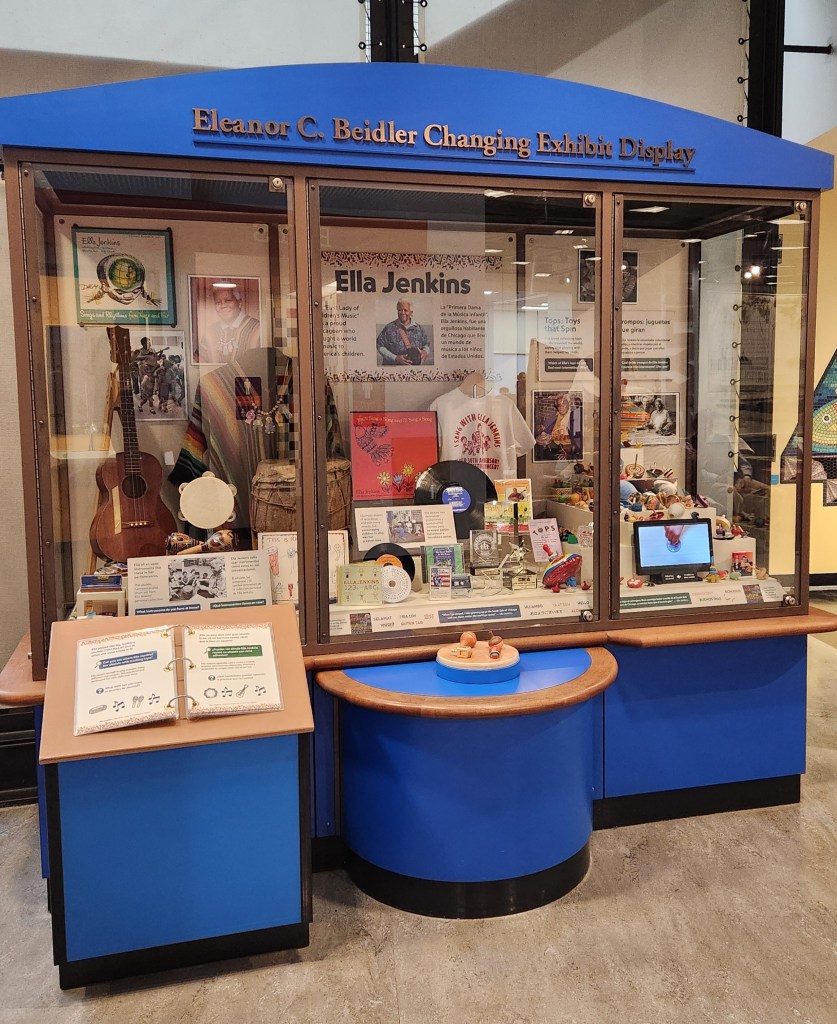
The exhibit explains that she liked tops because playing with them helped her to think.


There is an old flier in the display case from a time when Ella brought some tops to the museum: “Come sing along and spin tops and dreidels with Ella Jenkins and Louis Berman” it invites.
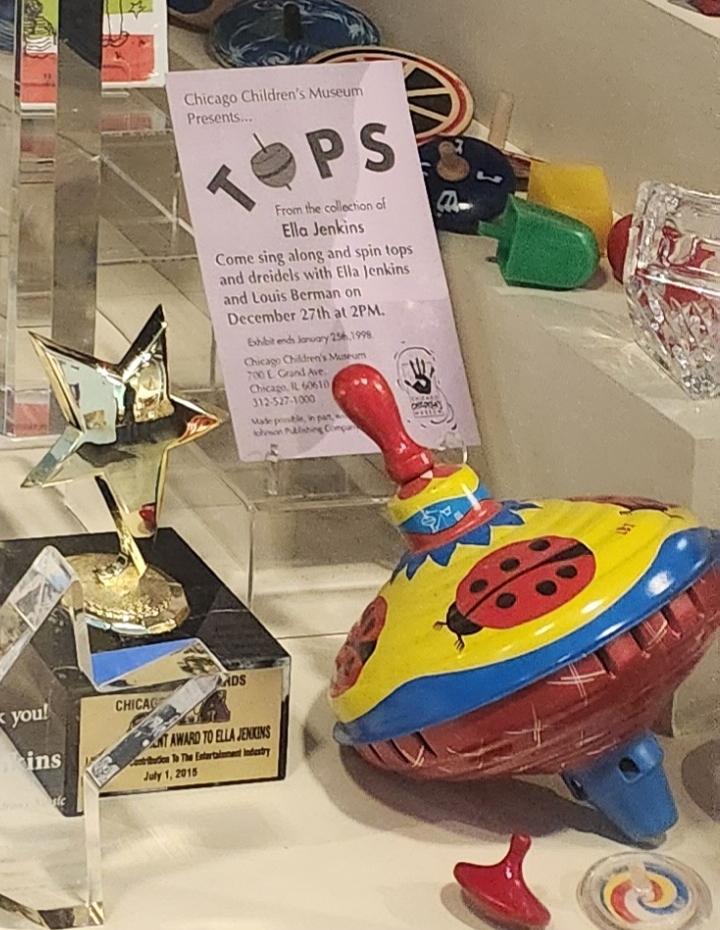
I was all ready to try the tops outside the display case but it turned out that they were permanently affixed, of course!


There actually wasn’t a Stitchtober list this year. For a short while it seemed as if there would be. In fact, Adam who had hosted the previous years Stitchtobers confirmed on Instagram that he was thinking he might do it again this year. But in the end he didn’t and since I had had the idea that I’d like to do it again using constellations, I went back to one of his previous lists from before I started participating.
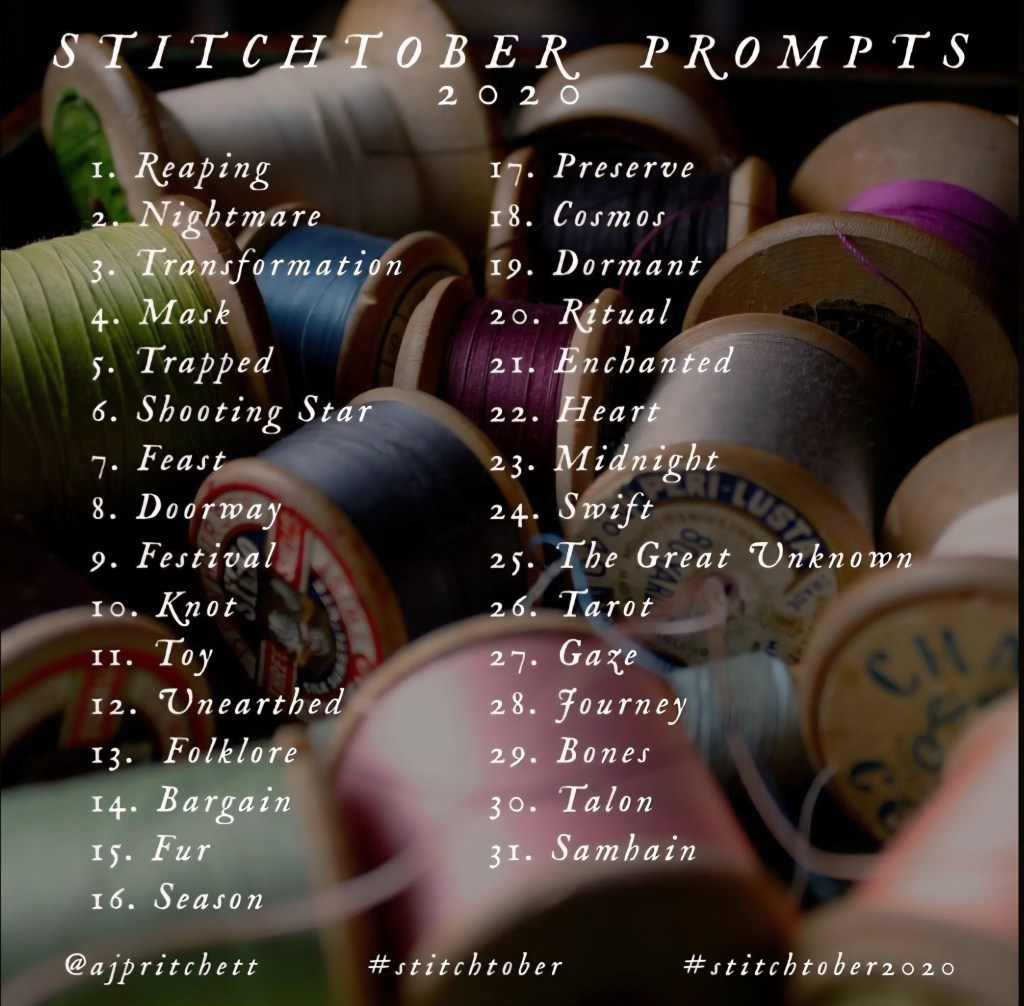
In 2020 Adam’s list included all 31 days of October but I only wanted to do Mondays, Wednesdays, and Fridays like the list was in 2021 when I did it for the first time. So after taking out a few of the words that I knew wouldn’t work with constellations I wrote the others on pieces of paper and had my husband pick 14 of them out of a basket.
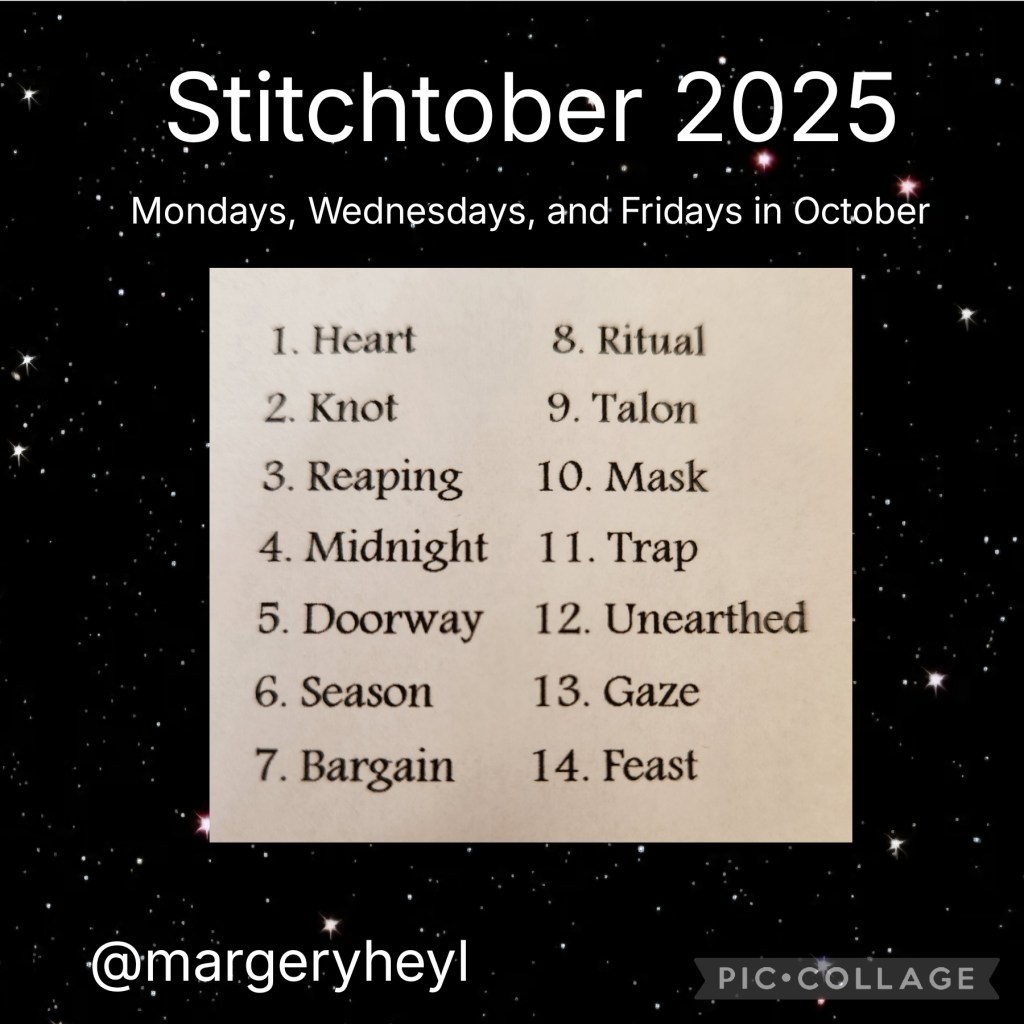
I was going to post my list on Instagram so I made a slide but I realized that, due to my design idea, I really wasn’t going to be able to stitch the constellations in the order I chose the prompts. This mobile, stitched by someone I follow on Instagram, was my inspiration for how to represent the constellations.


I knew I wanted to stitch them in a circle and through googling I found this cross stitch pattern.

After googling each of the prompts and deciding on which constellations to stitch, I began googling drawings of the actual constellations and drawings of the representations of them. I quickly found out that neither the actual constellations or the representations (or the stories that go along with them, for that matter) are consistent. So I picked the images I wanted to use and began arranging them in the large circle I had drawn on my pieces of taped together graph paper. As I began converting to x’s, I realized I wasn’t going to be able to stitch lines connecting the stars and that I was going to need to start stitching in the middle of the piece with Aquarius who was a response to the prompt “talon” which was number nine on my list. So I ended up posting the constellations on Instagram as I stitched them. Here are the first nine (from the bottom up) on my Instagram grid.
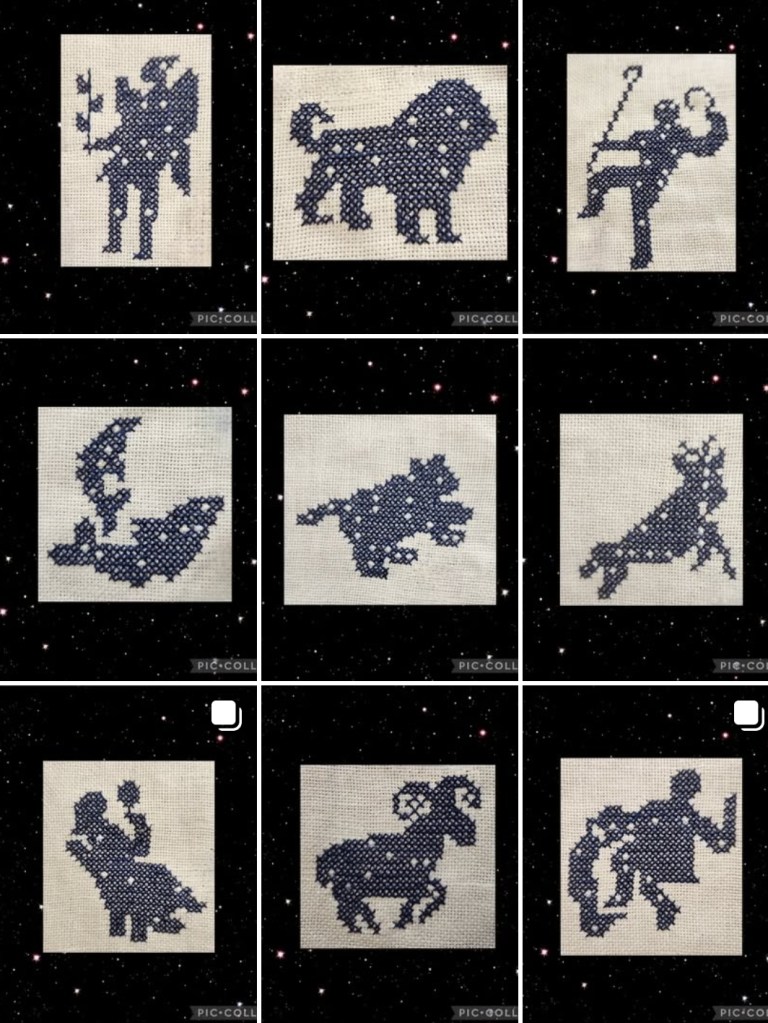
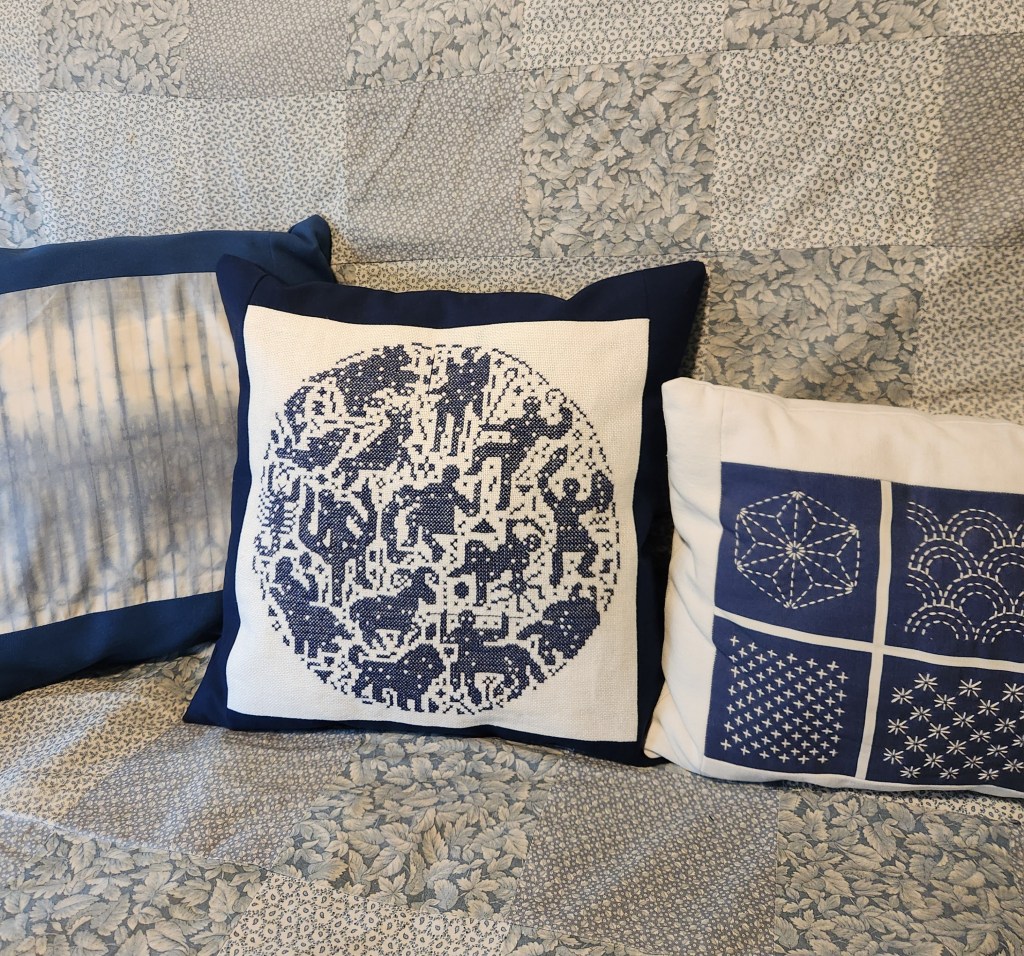
And here is the post of the piece with all 15 constellations. 15 because for the prompt “season” I stitched Orion and Scorpio who appear on opposite sides of the sky According to the myth, Orion hunts in the winter and flees in the summer when the scorpion appears.

After I had stitched all the constellations I added stitches to fill in the spaces a la the Kitties in the Round pattern and then I turned it into a pillow for our work/guest room futon.

It may look like Christmas at other people’s houses already but over here it is still Fall. I already wrote about some of our Fall decor – the sunflower picture I needlefelted and the Day of the Dead offrenda ornaments and the new quilt my Brooklyn niece gave me for Christmas last year – so here’s the rest of it.
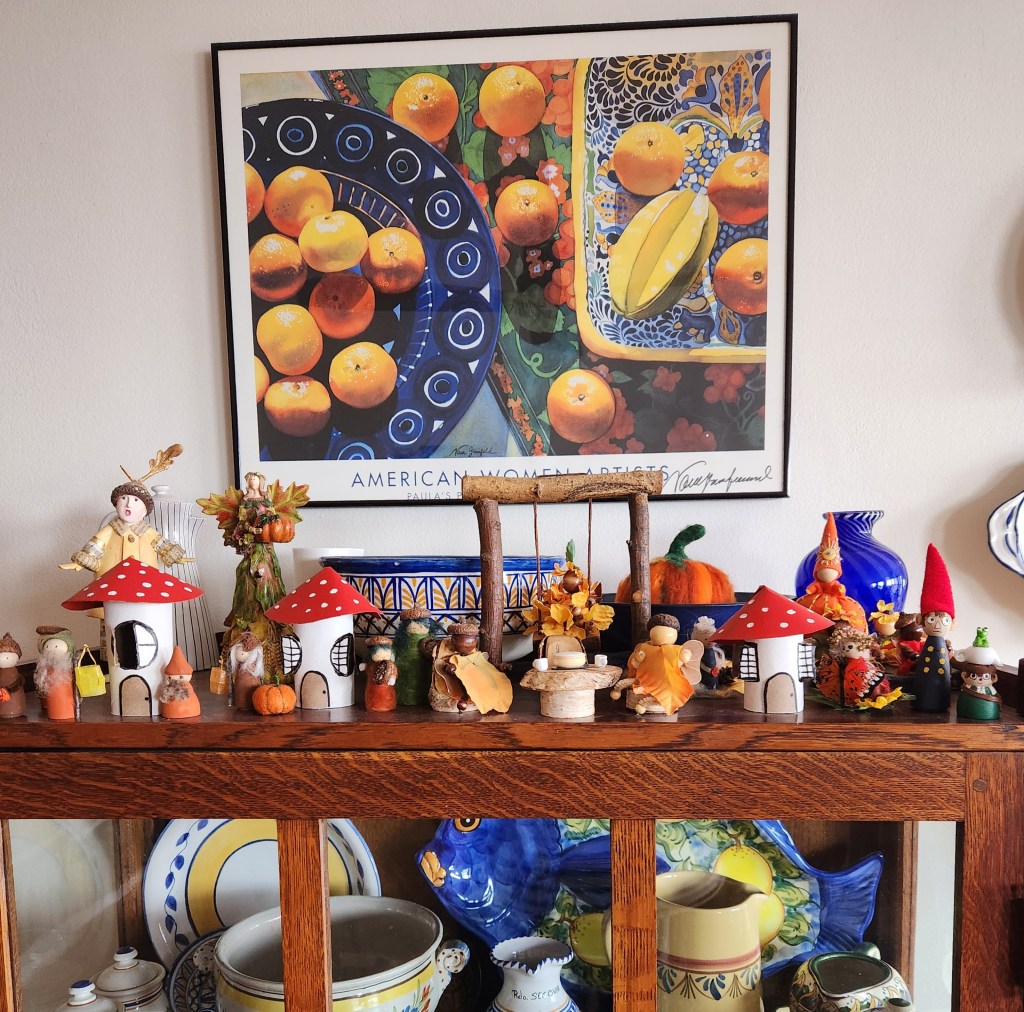
I was inspired to make these little mushroom houses by @studio_rosie on Instagram. I made the little tiny pumpkin in front of the second one (from the left) after taking an online workshop with Mirjam Gielen. It was wet felted in a tea strainer and embellished with embroidery thread.
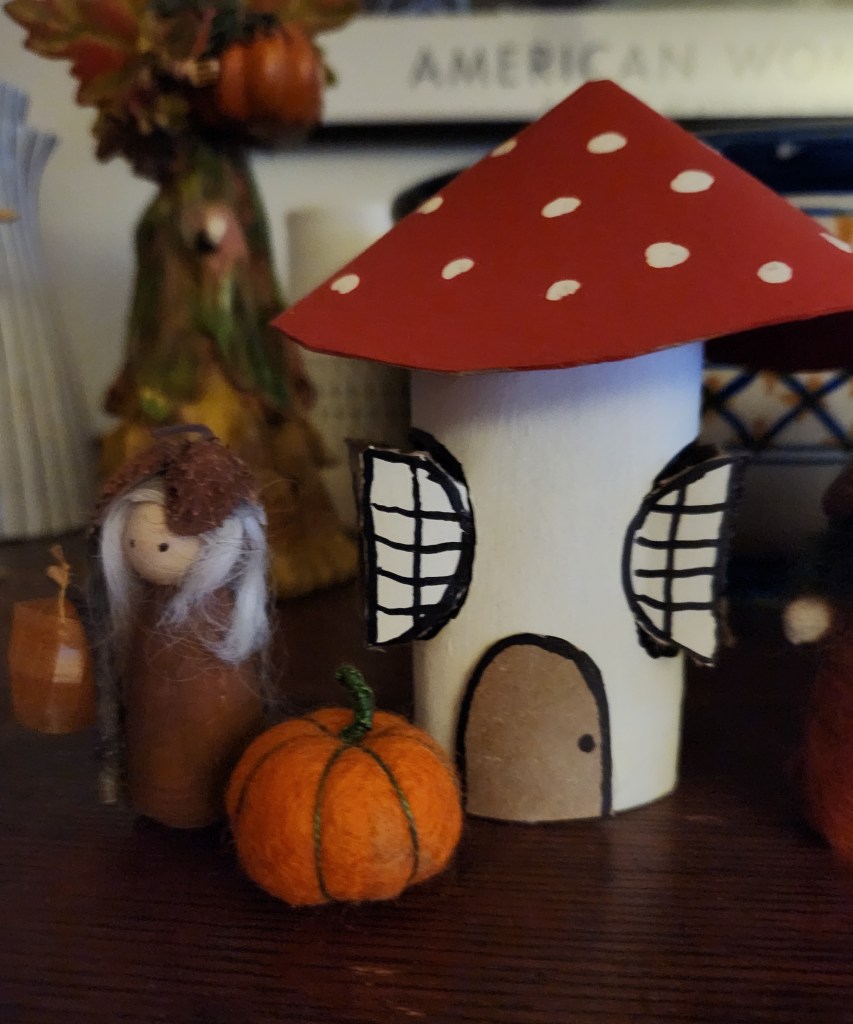
I went to Marshall’s the same day I watched the tutorial and couldn’t believe that they actually had a round tea strainer! I made an apple too and I intended to make an Evil Queen (from Snow White) pegdoll to hold it but had trouble drawing the face – maybe next year.
We put the Halloween trees in the living room again this year.

I didn’t feature the heirloom ornament I made for it last year because I was making other ones as a Christmas surprise.

I made some ghosts out of an egg carton after they flashed by quickly in an Instagram story. I intend to hang one or two on the trees next year but this year I made a garland of them and hung them in the dining room under the Fall branches.
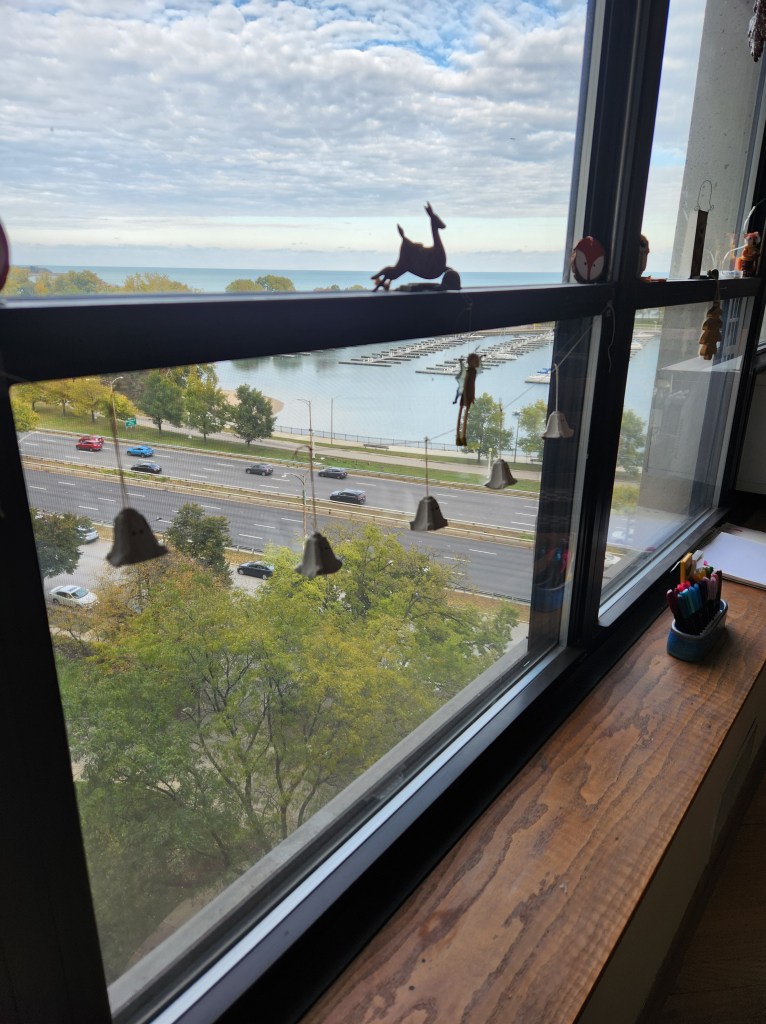


I took them down today because when it actually snowed this morning I thought “Well I guess I should take down the Halloween decorations” but it is obviously still Fall out there!
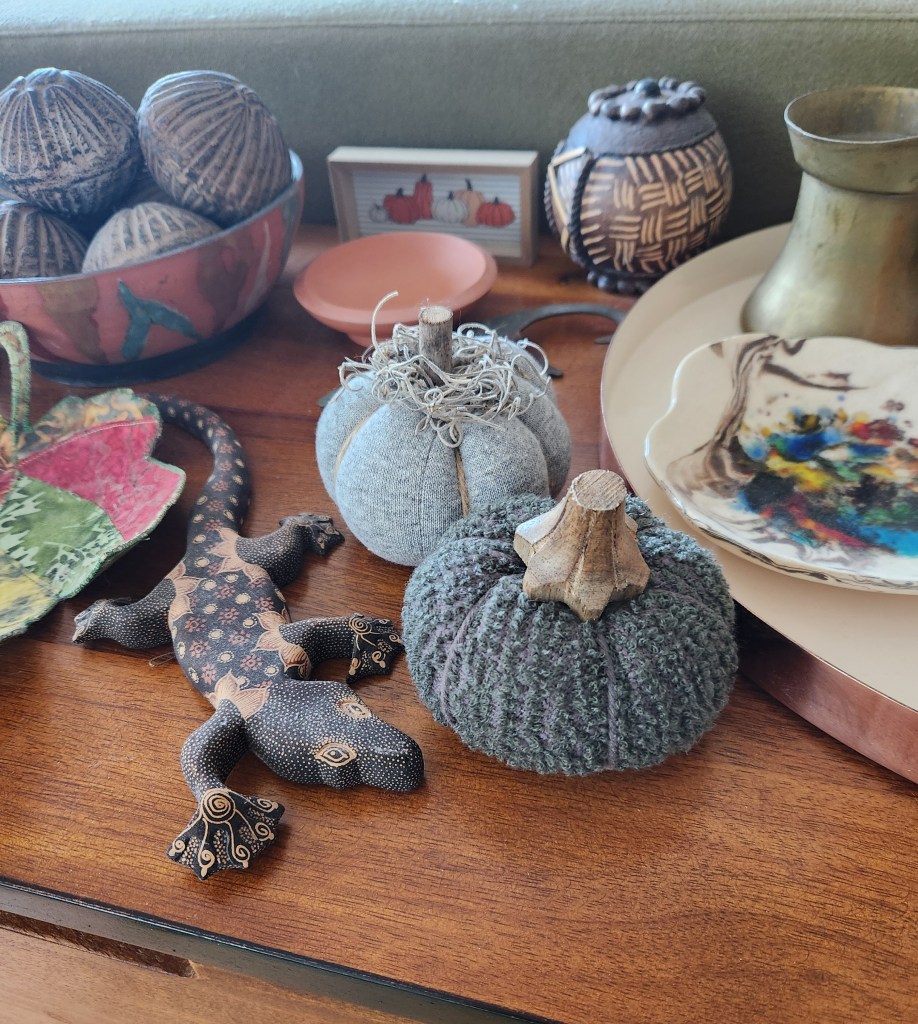
The only thing we bought this year was this little grey fuzzy pumpkin. When we saw it during the Andersonville Sidewalk Sales we knew it had to join the other grey pumpkin we bought at the Found Cottage a few years ago.
Last year Four Sided featured old scary movie posters in their Halloween windows and I knew that was what I wanted to use for my treats this year. I found one that was perfect – several people commented on the fact that Vincent Price was in it. I paired it with Kit Kat Ghost Toasts (apparently they tasted like Cinnamon Toast Crunch cereal) and simply wrote “Boo!” on the back in orange.

The treats are all gone now and the Halloween decorations are back in the storage box but happily the Fall decorations will stick around until the end of November!

 Collections and Other Stuff I Like