The Alternative to Appropriation

I have always admired and been inspired by other cultures and appreciated artists who were as well (Alexander Girard, for example), so I was disturbed a few years ago when it suddenly seemed that almost everyone was being accused of appropriation.
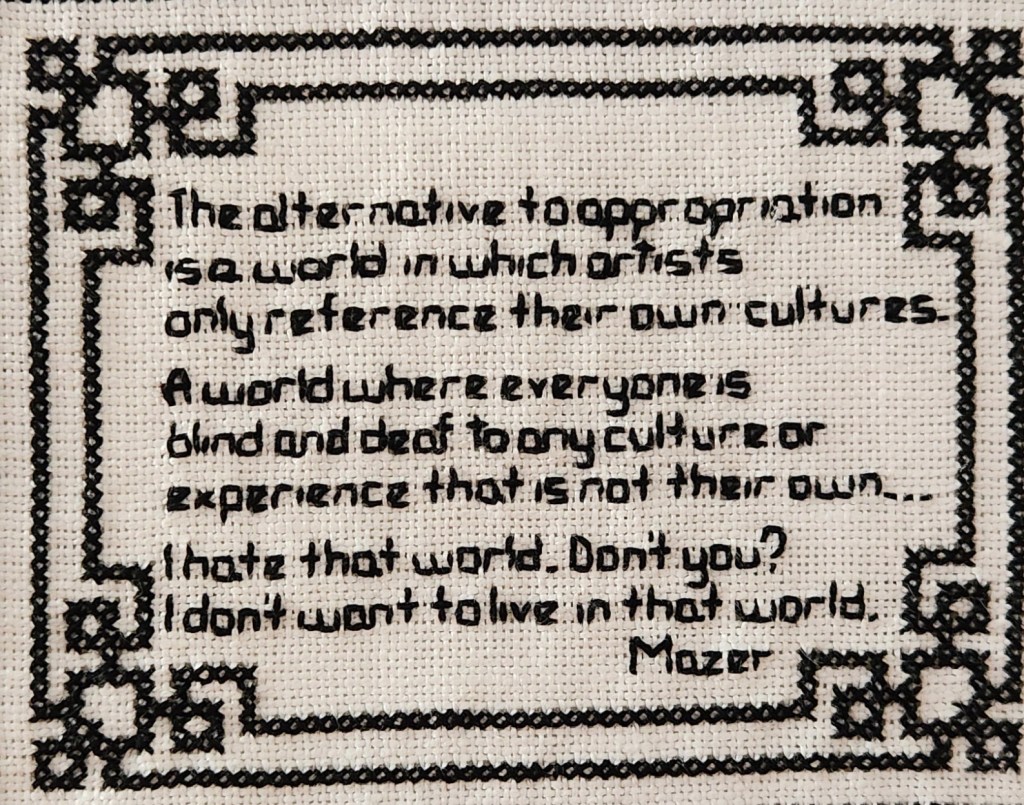
Recently when I read “Tomorrow and Tomorrow and Tomorrow” by Gabrielle Zevin, I was struck by the character Sam Masur’s response during an interview to accusations of appropriation in the video game he created with his friend Sadie Green. Sam, who at this point in the story is going by the name Mazer responds: “The alternative to appropriation is a world in which artists only reference their own cultures.” The interviewer responds, “That’s an oversimplification of the issue.” Mazer continues: “The alternative to appropriation is a world where white European people make art about white European people, with only white European references in it. Swap African or Asian or Latin or whatever culture you want for European. A world where everyone is blind and deaf to any culture or experience that is not their own. I hate that world, don’t you? I’m terrified of that world, and I don’t want to live in that world, and as a mixed-race person, I literally don’t exist in it.”
Yes, I thought that’s it and wrote the quote down. After picking up the piece of paper and reading it again many times, I realized I wanted to embroider an abridged version of it.
I thought I’d use the same small alphabet I had used for the “Angel from Montgomery” piece, and I thought it would be perfect to surround it with folk art borders from many countries. I knew I wanted to use the Scandinavian selburose (eight pointed star) I had used before on Christmas cross stitch pieces and the Greek key pattern I had used in my Greek myths piece and that I first saw on to- go coffee cups and have always loved.

Those two choices led to the decision to use four closed borders and four border elements. I searched through the resources I had and did some Internet searching to find the rest of the elements. An internet search for “Chinese cross stitch border” yielded a pattern that I didn’t think would work with my initial concept, but would be perfect to frame the quote.
I found another border in an old DMC Library Morocco Embroideries book that used to belong to the Heath Library. My sister had rescued it for me when the library discarded it many years ago.

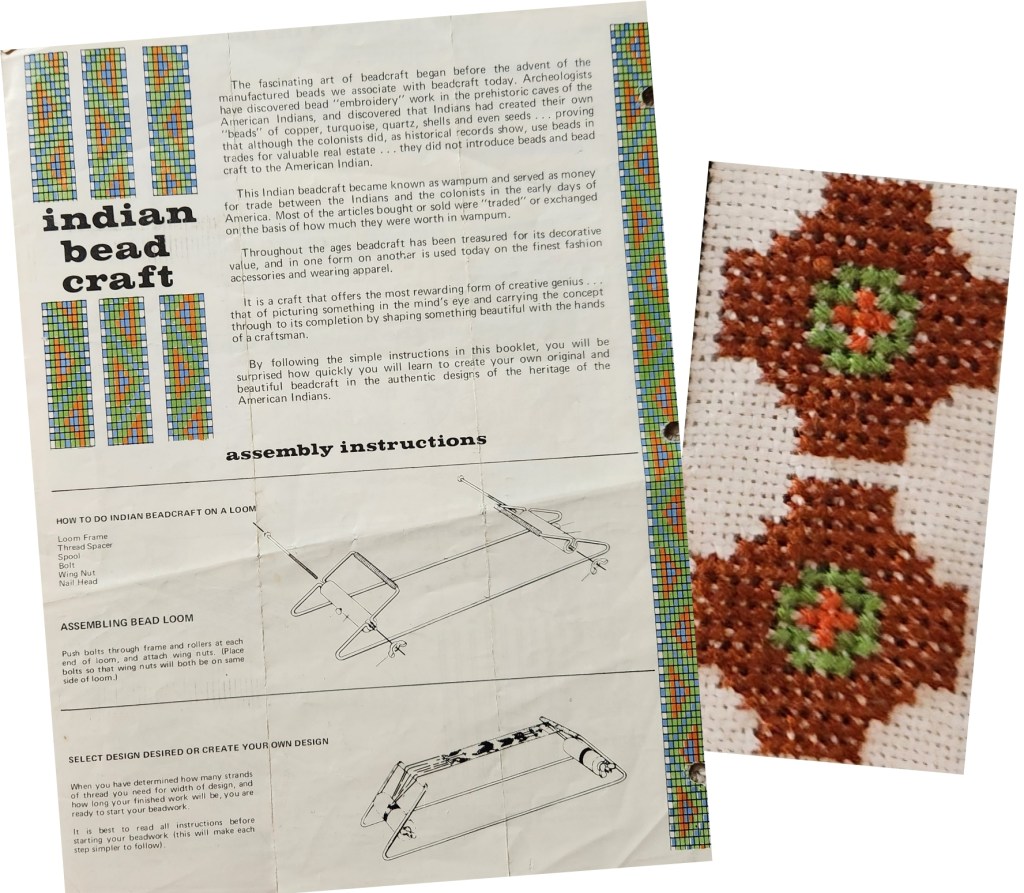
I adapted the Native American pattern from the directions that came with a beading kit. I don’t think I ever successfully made anything with the beading kit, but I saved the directions and have used them when designing cross-stitch patterns before.
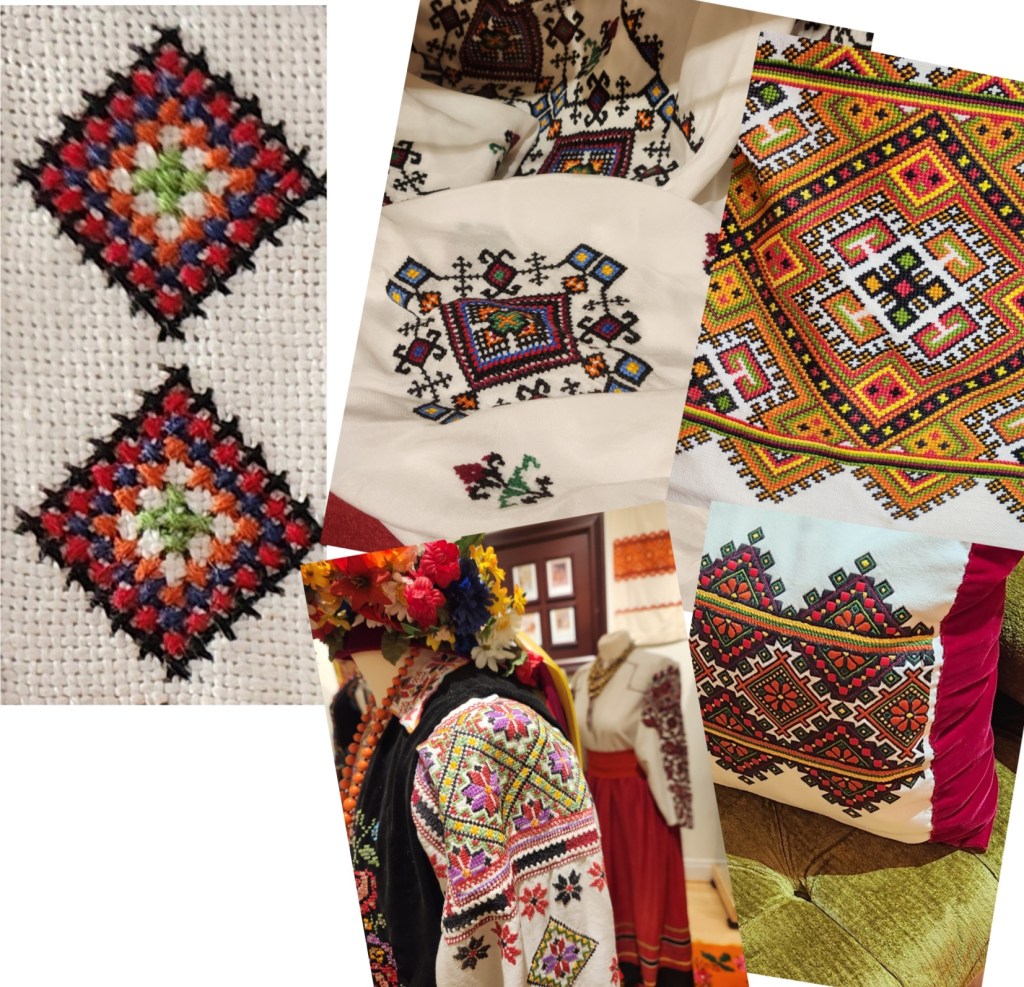
While I was still thinking about the piece, I went to the Ukranian National Museum and snapped some photos of embroidered pieces, which inspired the color choices for the Ukranian pattern I found by doing an Internet search.
An internet search also led to the Celtic border, which is probably the hardest thing I have ever stitched. It was made even harder by the fact that I ran out of the thread, which I think would have been hard to match, while I was stitching it.

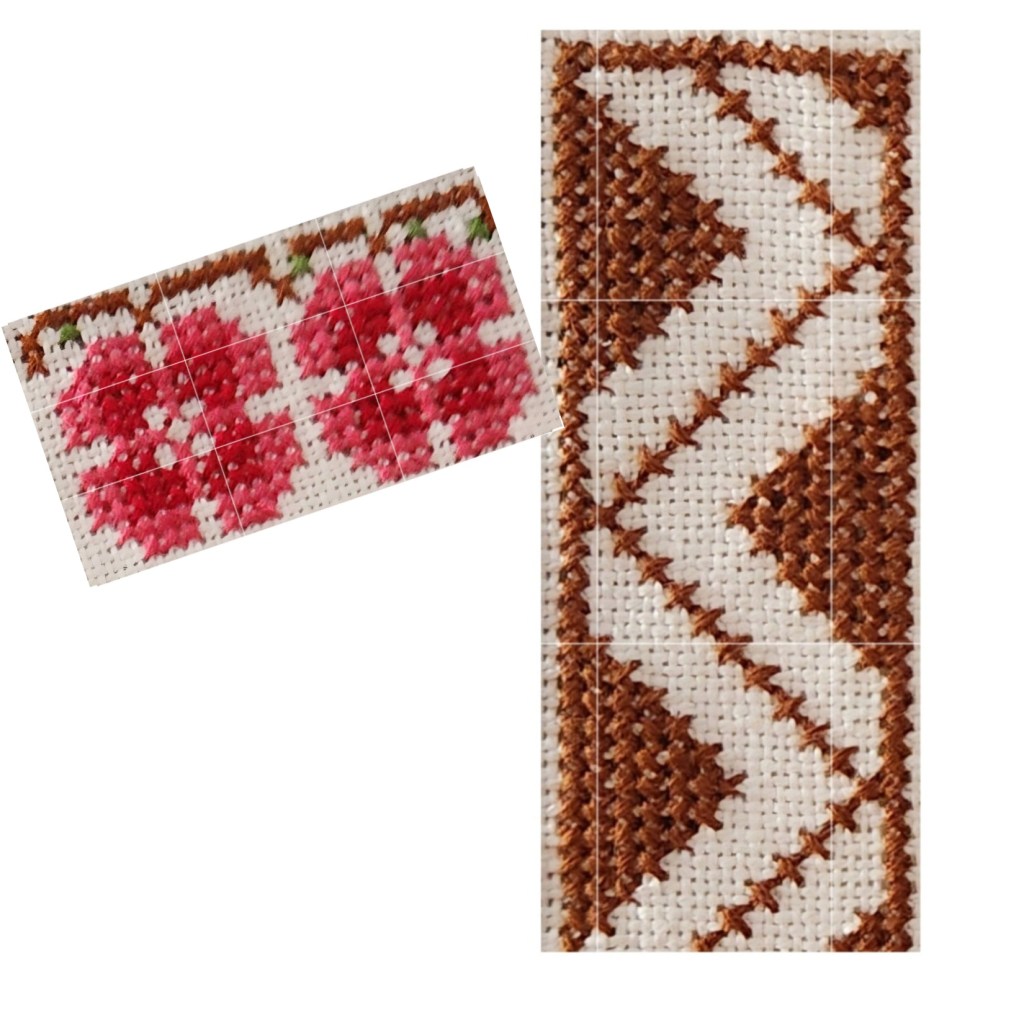
My internet search didn’t lead to any Japanese borders, so I adapted the cherry blossoms from another pattern I found. Finally, I designed a border meant to evoke Kente cloth.
When it came time to frame it I thought it didn’t make sense to frame what was essentially already a frame so I decided to use a stretched canvas like I had with the “Never Let The Old Woman In” piece. But this time, I had to make my own canvas, which worked well, although I’m not entirely satisfied with the mounting.
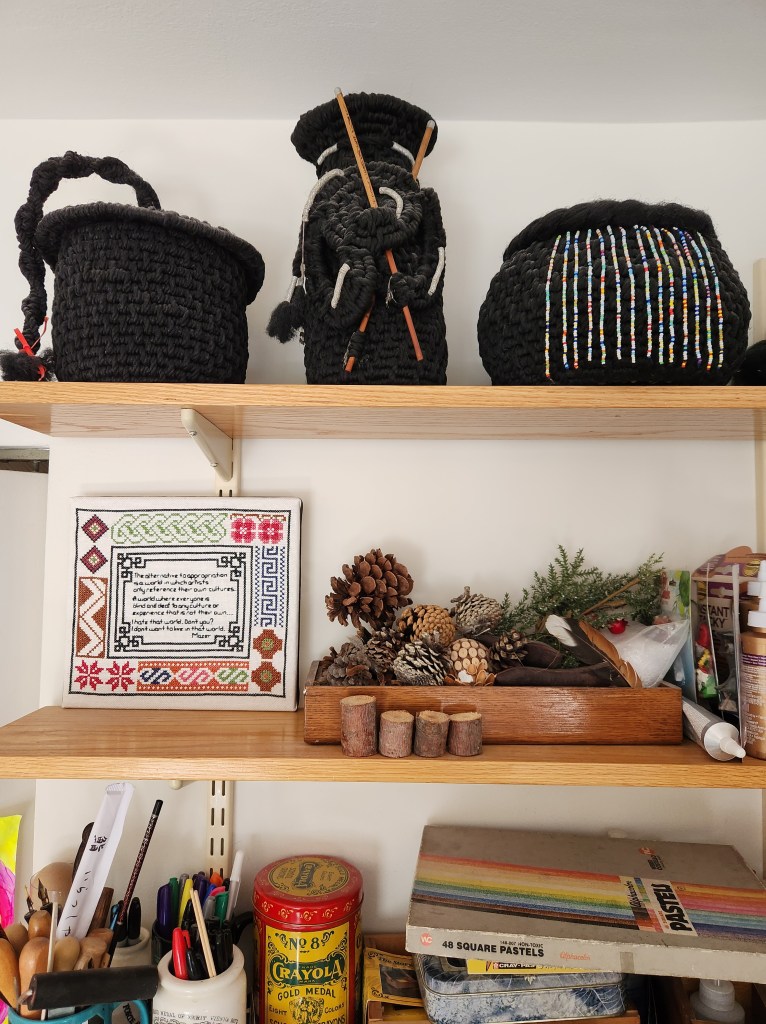
I think I found the perfect place to display it, though. Right under the hair baskets I made many years ago which some might accuse of being good examples of appropriation.

 Collections and Other Stuff I Like